
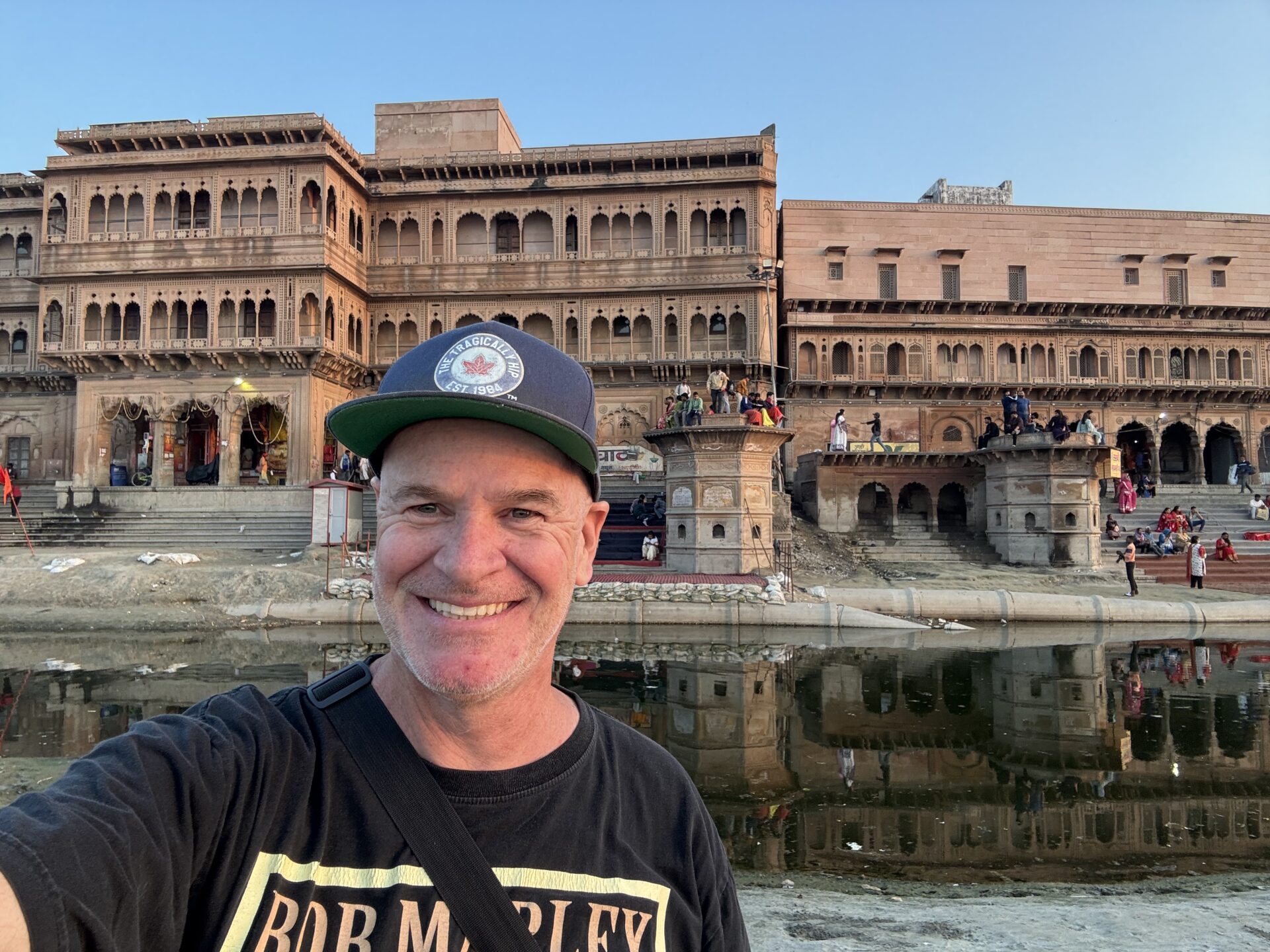
Vrindavan, India, is not on most Western travelers itineraries, but it should be. Vrindavan is one of India’s most important spiritual cities, home to ancient Hindu temples. If you are looking for an authentic India experience with constant chants, sacred rituals, chaos, roaming monkeys, and narrow streets overflowing with devotion to Lord Krishna, add Vrindavan to your India travel plans. The city attracts devout Hindus to come and experience famous sites such as Banke Bihari Temple, Prem Mandir, ISKCON Vrindavan, and Keshi Ghat. Whether you are visiting for a single day or planning a deeper spiritual journey, this Vrindavan travel guide covers the most important temples, how to get around, where to eat, and essential tips for first-time visitors.

While traveling through India, I was constantly reminded that Vrindavan hosts the country’s most famous and lively Holi celebration. I didn’t make it for Holi, but I was there for the pre-Holi celebrations and experienced the energy, passion, lively chants, and pilgrimages that make this city so special and one you should not pass up on your trip to India.
This post contains affiliate links, which means I may earn a small commission if you make a purchase through one of them at no extra cost to you. I only promote travel brands that I use myself.
Vrindavan is only a couple of hours by train from New Delhi, making it easy to add to your Golden Triangle adventure.
Booking trains in India can be complicated, so I use 12Go to book my tickets before I arrive. 👉 Here is my 12Go affiliate link.
What This Vrindavan Travel Guide Covers
This travel guide is intended to help you plan your trip to Vrindavan. It covers the best temples to visit, suggested itineraries, how to get there and around the city, the best time to visit, festivals to plan your trip around, temple tips, and where to stay and eat.
Vrindavan Travel Guide Map: Best Temples to Visit
These are the temples in Vrindavan I visited, featured in this travel guide. There are over 5000 temples in the city, and many others that are also important, but these are at the very top of the list. Banke Bihari, Prem Mandir and the ISKCON temple are absolute must-visits in Vrindavan.
Vrindavan Travel Guide: Must-Visit Temples
The reason you are adding Vrindavan to your India itinerary is to visit the city’s beautiful temples. All of the city’s temples are dedicated to Lord Krishna.
To many Hindus, Lord Krishna is their most important God, which explains why Vrindavan is such an important temple city. According to Hindu tradition, Krishna spent his childhood in and around Vrindavan, and the city remains one of India’s most important spiritual destinations.
subscribe to my newsletter for Hidden Gems, Smart Tips, travel guides and Honest Reviews
Banke Bihari Temple – The Heart of Vrindavan
Speaking of Lord Krishna, Banke Bihari is the most important temple in Vrindavan and one of India’s most revered. For this reason, it is my first stop in this Vrindavan travel guide.
The Pilgrimage to Banke Bihari Temple
I decided to get up early and walk to Banke Bihari Temple in the heart of the old town to beat the crowds by arriving as soon as it opened. It was about a 20-minute walk from where I was staying near Prem Mandir Temple. It’s a pleasant walk through the narrow streets, with plenty of opportunities to grab breakfast and a chai, and to do some shopping if you like. You will pass many sacred cows and monkeys on the street, making for an entertaining journey.
Banke Bihari Chaos, Chants and Rituals
I’m strolling along, following Google Maps, when I reach the center of the Old Town and everything comes to a halt. It’s pure chaos. I check my phone and see I have only about 400 meters to go. As it turns out, this section will take hours to reach the temple.
As I arrive at the main road, a police officer stops me to remind me that I need to remove my shoes and socks. She points back in the direction I came from to a shoe stand I can’t see. I eventually find it and begin my journey to the temple barefoot. This is a temple rule that applies to all Hindu temples.
I joined thousands of Lord Krishna worshipers for the rest of the journey. There were sacred cows lining the streets, monkeys on overhead wires, constant chanting, shops, and a high-energy vibe. I was literally cramped like a sardine, as if I were at a rock concert in general admission. A worshiper beside me asked if I was having fun. Ha! He then shared that he comes to this temple once a month from Delhi, reinforcing its importance.
Inside Banke Bihari Temple
Finally, we reached the temple. It’s not flashy or impressive from the outside, but as you step inside, you can feel the devotion and intimacy of this temple. It was so crowded I could hardly lift my arms to take a picture, yet the experience was surreal. I moved swiftly through the chanting crowds, caught a glimpse of Lord Krishna, and left. This isn’t a place to wander; it’s quick, pure chaos, and you leave.
Side note, I didn’t see any other Westerners during this temple visit. My Instagram video really captures the experience.

👉 The Golden Temple in Amritsar is another one of India’s most iconic temples. Check out my Amritsar travel guide and itinerary.
Prem Mandir – Evening Lights and Architecture
At first glance, Prem Mandir resembles a Disney Castle more than a temple, which you need to see at night. This modern white marble temple lights up in colours like blue, pink, green and red. The temple is surrounded by fabulous fountains and gardens, making the property look even more stunning.

The interior is just as impressive. It’s much calmer than Banke Bihari Temple, yet still lively with chants that resemble a concert or a World Cup football match. The temple features white marble and carvings throughout. This temple is unlike any other I have visited anywhere in the world.

The temple is dedicated to Lord Krishna and Radha and embodies love, faith, and service to God. For most visitors, it’s a place for prayer, reflection, and to connect with stories from Krishna’s life.
If you’re interested in iconic Indian temples, both Prem Mandir and Banke Bihari Temple are featured in my Top Temples in the World blog.
ISKCON Vrindavan – Peaceful Chanting and Atmosphere

Just up the street from Prem Mandir sits another of Vrindavan’s best temples, the ISKCON temple. This beautiful temple is especially striking at night. It also has a white marble exterior that is stunning in the evening, with domes, arched walkways and marble carvings.
People leave their shoes and socks outside the temple, and I did the same. I was a bit nervous about leaving them on the sidewalk, but I was assured there was no chance anyone would steal them, and it turned out to be true.
The official name of the temple is Sri Sri Krishna Balaram Mandir, which matters, especially if you’re using Google Maps. The night before, I tried to find the ISKCON Temple on Google Maps, and it took me to a local neighbourhood in the middle of nowhere. Google Maps uses the official temple name, Sri Sri Krishna Balaram.
As you step into the complex, you’ll find a serene courtyard with a beautiful view of the surroundings. To the left is a sacred shrine where worshippers sing as part of a ritual that anyone can sit in and join. On the right, there is another building where you can buy souvenirs and food.

Inside the ISKCON Vrindavan Temple

Inside the temple, the vibe is very chill and serene. The chants are calm and peaceful, with coordinated dances and bands playing music. The atmosphere is completely different from that of Prem Mandir or Banke Bahiri.
Worshipers wave lamps and ring bells before Krishna and Balaram. As the night progresses, the singing builds to a climax before coming back down again.
The atmosphere continues as you exit, with the musicians performing on the street. This was a deeply spiritual experience.
Temple Tip: The street connecting ISKCON and Prem Mandir offers a market experience, with street stalls, restaurants, and shops along the way.
Keshi Ghat – River Aarti and Spiritual Atmosphere
Keshi Ghat temple was added to my Vrindavan travel guide not only for its location on the Yamuna River but also for its architecture and spiritual significance. If you are staying in the old town, it’s about a 15 to 20-minute tuk-tuk ride.
The temple buildings feature arched balconies, carved windows, domes, and fading pastel colours that reflect centuries of devotional history, with sandstone steps descending to the Yamuna River.
Go For A Keshi Ghat Yamuna River Sunset Cruise
My hotel manager recommended this spot as a hidden gem in Vrindavan, with the sunset boat cruise on the Yamuna River as its main attraction. Beyond the city’s “big three” temples, he insisted it was the next must-visit experience.
At Keshi Ghat, dozens of small boats line the riverbank, offering short sunset cruises along the sacred Yamuna River. The journey lasts about 30 minutes in a shared boat carrying roughly ten people, gliding upstream and then back again. The real highlight is the view—watching the light soften over Keshi Ghat and the surrounding temple architecture as the river reflects the fading sky in gold and orange.
The cost for the boat started at 1000 rupees, and I brought it down to 400. I thought I was the only person on the boat and had it to myself, but I was tricked. As the boat was about to set sail, 4 kids jumped on board, joining for a free sunset cruise on my dime. They were posing for videos and photos like they were making a rap video. This didn’t bother me at all, as it was clear this was a huge experience for them, and they were taking in the moment just like I was. It meant more to them than it did to me.
When I returned to the beach, there were groups of people sitting on the wide stone steps and raised stone platforms, taking in the magical moment. It was a surreal and spiritual experience.
Rituals, Ceremonies and Spiritual Atmosphere
The temple itself is very long, with many rituals both inside the buildings and along the banks of the Yamuna River. I walked as far as I could, then turned back, making an evening of it with many stops along the way.
Along the ghats (sacred access points to the river), people bathe in the river, light candles at dusk, and gather for the evening Yamuna Aarti, creating a spiritual atmosphere that feels constant late into the evening.

The Keshi Ghat Aarti Ceremony
The main event of the evening, the Keshi Ghat Aarti Ceremony, also commonly called the Yamuna Aarti, caps off each day. It is a devotional ceremony featuring lamps, chanting, bells, flowers, and prayers offered to the Yamuna River. As you walk, you see these ceremonies taking place at different points and times along the way. There is always a new ceremony to sit down and enjoy. You can spend hours here, soaking up the spiritual vibe.
Priests chant mantras, ring bells, and offer flowers, incense, and lamps during prayer ceremonies, while devotees sit in quiet reflection, sing bhajans, or make offerings to the river.
This temple has so much going on that you can easily spend an entire evening here. There are even food stalls and restaurants along the water if you want to relax and enjoy a meal.
As you exit the entrance, there are tuk-tuks available so you can safely make your way back to the old town.

If you’re looking to explore another major temple city in India, Bhubaneswar is a great choice. Known as the “Temple City,” it has hundreds of historic shrines dating back to the 4th century.
👉 You can read more in my blog, Top Temples in Old Town Bhubaneswar (Walking Route).
Vrindavan Travel Guide Itinerary: 1–2 Day Temple Plan

Here are two recommended Vrindavan travel guide itineraries for your stop in Vrindavan. I suggest the 2-day itinerary so you are not rushed, but I am also including a 1-day itinerary for those pressed for time. The temples are the main reason tourists visit Vrindavan, so they are the focus of these itineraries.
If you are planning to eat out, the areas around the Prem Mandir and the Old Town near Banke Bahiri are your best options. These areas have many street-food stalls and restaurants. Don’t expect anything fancy, but the food in Vrindavan is amazing. If you would like to order in, download the Zomato app, India’s equivalent to Uber Eats.
There is also excellent shopping for souvenir hunters in these areas. In addition, all the popular temples have many dining and shopping options nearby.
Two-Day Vrindavan Temple Itinerary (Relaxed Spiritual Visit)
On the two-day itinerary, I’m adding 5 more of the best temples in Vrindavan that you can include in your Vrindavan itinerary. I’m also including a few bullet points highlighting these additional temples.
Day1
Morning – Make the pilgrimage to Banke Bahiri Temple
Get up early and aim to arrive by 8 am, when it opens. Spend the rest of the morning exploring the old town, then have lunch.
Midday – Radha Raman Temple
- One of the oldest and most revered temples in Vrindavan, established in the 1500s
- Houses a self-manifested deity of Lord Krishna (no external idol was installed)
- Much quieter and more intimate compared to the main tourist temples
- Known for its deeply traditional rituals that have remained unchanged for centuries
- A peaceful space to sit and absorb the spiritual atmosphere after a busy morning
Afternoon – Radha Vallabh Temple
- One of the most spiritually significant temples in Vrindavan, dedicated to Radha as the supreme deity
- The temple has a very intimate, old-world atmosphere compared to larger sites like Prem Mandir
- Known for its simple yet deeply emotional style of worship and chanting
- Fewer tourists, making it ideal for a quiet and reflective spiritual stop
Finish at Prem Mandir and ISKCON
After your busy day touring the temples, grab dinner, head back to your hotel to rest, then visit the 2 best temples in Vrindavan, both famous for their evening shows. Start at Prem Mandir, then head over to ISKCON, about a 10-minute walk on the same street.

Day 2
Morning – Madan Mohan Temple
This is one of the oldest and most historically important temples in Vrindavan.
- Perched slightly above the river area (near the Yamuna side)
- Feels quieter and more “ancient Vrindavan” compared to Banke Bihari
- Great for early morning calm before crowds build
Midday – Radha Damodar Temple
A deeply significant temple with strong historical roots.
- Has sacred sites of key saints in the courtyard
- Very devotional, but not tourist-heavy
- You can sit here longer without feeling rushed
Afternoon – Govind Dev Ji Temple
A stunning red sandstone temple that once rivalled the grandest temples in India.
- Originally part of a massive 7-storey structure (mostly destroyed historically)
- Still incredibly impressive in scale and design
- Very photogenic in late afternoon light
- Strong historical connection to the Jaipur royal devotion
Sunset/Evening Finish at Keshi Ghat
Keshi Gate is the perfect end to your 2-day Vrindavan itinerary.

One-Day Vrindavan Temple Itinerary (Quick Visit Plan)
With the one-day itinerary, I’m not going to go into as much additional detail, as these temples are well covered in the Must-Visit Temples in Vrindavan section.
Sunrise at Keshi Ghat
At sunrise at Keshi Ghat in Vrindavan, the Yamuna River turns a soft gold as the first light reflects on the water and the riverside temples slowly come to life. The air is calm and devotional, with morning bells and chants drifting across the ghats as pilgrims begin their rituals.
Afternoon – Pilgrimage to Banke Bahiri Temple

Grab lunch in the old town, then visit Banke Bahiri Temple.
Evening – Prem Mandir
Grab dinner at one of the restaurants across the street before heading to Prem Mandir for the evening show. There is shopping, entertainment, and ice cream stands, with plenty of fun to be had in the area. You can also come back here at the end of the night after your visit to IKCSON Temple.
Finish off at IKCSON Temple
Vrindavan Travel Guide: How to Get There & Get Around
How to Reach Vrindavan from Delhi
The easiest way to reach Vrindavan from Delhi is by train. It’s only about a 2-hour train ride.
Booking trains in India from abroad can be tricky, so I use 12Go. It simplifies the process and handles the logistics, and you can sometimes still find seats available even the day before travel.
👉 Here’s my affiliate link for the Delhi to Vrindavan train.
Beware of scams at the New Delhi train station. 👉 Check out my blog, India Tourist Scams Every First-Time Visitor Should Know, which covers common scams at the Delhi train station.
Mathura Junction Train Station and Getting to Vrindavan
When taking the train to Vrindavan, you arrive at Mathura Junction railway station. Outside the station, there are many taxis and tuk-tuks, but bring your best negotiating skills. Rates start at 600 rupees, but don’t pay more than half that. I negotiated a tuk-tuk for 250 rupees, which is about what locals would expect to pay. It’s about a 20-minute taxi or tuk-tuk ride to the old town.

Local Transport Between Temples

The best way to get between Temples is to walk whenever possible. Most streets are very narrow, so Uber won’t work, and you won’t see tuk-tuks or taxis on them. If you are staying in the old town, Prem Mandir, Banke Bihari, and ISKCON are easily walkable. If you do need to order a taxi or tuk-tuk and are staying on a narrow street, walk to a main road, flag one down, or order an Uber from there.
👉 Read about how I explored Jaipur by tuk-tuk. My one-day Jaipur tuk-tuk tour experience.
Vrindavan Travel Guide: Where to Stay
In my opinion, the best place to stay in Vrindavan is the Prem Mandir temple area. It’s quieter than the chaotic old town and close to 3 of the 4 temples featured in this Vrindavan travel guide. Even though it’s less chaotic, it still has excellent street food, many restaurants, shopping, and everything you need nearby for a great stay.
The old town has some great options, too, but it’s intense and chaotic. If you love high energy, large crowds, and chaos, stay in the old town.
👉If you are looking for a nice hotel near Prem Mandir, check out my affiliate link for Hotel RN Residency – Near Prem Mandir, Vrindavan, which is where I stayed while in Vrindavan.
Vrindavan Travel Guide: Where to Eat Near Temples
Vrindavan’s food scene is closely tied to its temples, so most nearby places are strictly vegetarian (no onion or garlic) and often served as prasad-style meals. You’ll find everything from simple street snacks to full thalis within walking distance of major sites like Banke Bihari Temple and ISKCON. This section of my travel guide breaks down the Vrindavan food scene.
Simple Vegetarian Food Options
In the temple areas (especially Banke Bihari and the ISKCON/Prem Mandir corridor), you’ll find easy, affordable vegetarian meals.

- Kachori Sabzi stalls – Freshly fried kachori with spiced potato curry and chutney, especially in the mornings near Banke Bihari Temple.
- Sattvic thali eateries (bhojanalayas) – Simple meals of roti, dal, rice, sabzi, and curd, usually without onion or garlic.
- ISKCON-style restaurants (Govinda’s) – Clean, sit-down vegetarian meals with Indian and light international dishes in a calm temple setting.
- Local chaat & street snacks – Aloo tikki, chilla, pakoras, and lassi stalls around temple lanes (best eaten fresh, especially in the evening).
These are the easiest “no-stress” options if you’re temple hopping all day.
Street food tip: Be careful with the little shortbread-style cookies sold on the street. They are baked fresh in a cast-iron outdoor stove. I tried them, and they were amazing, but they upset my stomach for about 24 hours. When I told my hotel manager what I ate, he knew right away it was those cookies that caused my stomach discomfort. He said it’s the oils, and that even he would get sick from eating them.
Temple Prasad and Local Snacks
Prasad in Vrindavan isn’t just symbolic—it’s a big part of the food culture.

- Mathura peda – The most famous sweet in the region, made from reduced milk (khoya) and cardamom. Often bought as an offering or for takeaway near temple markets.
- Makhan mishri – white butter with rock sugar, traditionally associated with Lord Krishna.
- Kulhad lassi – a thick, creamy yogurt drink served in clay cups near temple entrances.
- Temple bhog/prasad meals – Simple, freshly cooked offerings distributed at temples or ashrams, often including rice, dal, and sabzi.
Many visitors pick up sweets like peda after darshan from small shops near Banke Bihari Temple. Just choose busier, cleaner-looking vendors for freshness.
Best Time to Visit Vrindavan Temples
Weather and Crowd Conditions
The best time to visit Vrindavan is between October and March, when temperatures are more comfortable for exploring temples and walking through the town’s narrow lanes. During these cooler months, daytime temperatures are generally pleasant, making it easier to visit popular sites like Banke Bihari Temple, Prem Mandir, and ISKCON Vrindavan.
Expect larger crowds on weekends and religious holidays, while weekdays typically offer a more relaxed experience. The summer months, from April to June, can be extremely hot, while the monsoon season brings occasional heavy rain that may affect sightseeing plans.
Festivals Like Holi and Janmashtami

Vrindavan comes alive during major Hindu festivals, making them some of the most memorable times to visit. Vrindavan hosts India’s most famous Holi celebration, celebrated with over-the-top enthusiasm and attracting pilgrims and travelers from around the world to witness the vibrant colours, devotional music, and unique traditions associated with Lord Krishna. If you haven’t been to a Holi celebration in India, be prepared to be absolutely smothered in vibrant colours. It’s a definite festival-party atmosphere.
I visited Vrindavan during the pre-Holi festivities, and honestly, that was more than enough for me. The city was extremely busy, with over-the-top energy and excitement. I can’t even imagine how crazy it must be during the Holi celebration.
Janmashtami, which commemorates Krishna’s birth, transforms the town into a spiritual spectacle with elaborate temple decorations, special prayers, devotional singing, and midnight celebrations. While these festivals offer an unforgettable cultural experience, visitors should be prepared for larger crowds, higher accommodation demand, and busier transportation.
Vrindavan Temple Etiquette and Safety Tips
Dress Code and Temple Etiquette

When visiting temples in Vrindavan, it’s important to dress modestly and respectfully. Both men and women should wear clothing that covers the shoulders and knees, and comfortable footwear is recommended because you’ll be walking frequently between temple complexes.
Visitors are required to remove their shoes before entering temple grounds, and some temples may prohibit photography in certain areas.
During darshan and prayer ceremonies, be respectful of worshippers, follow any instructions from temple staff, and avoid pushing through crowds. A courteous, patient approach will help you fully appreciate the spiritual atmosphere that makes Vrindavan one of India’s most sacred pilgrimage destinations.
Monkey Safety Around Temples
This tip in this Vrindavan travel guide could save you thousands of dollars – no joke. The monkeys in Vrindavan are the most aggressive I’ve seen throughout my travels. Especially in temple areas, keep your phone in your pocket, don’t wear sunglasses, and keep all your valuables, like your wallet, secure. If you don’t, the monkeys will take them.

So no texting or taking pictures with your phone outside the temple. The monkeys will take your valuables, and you won’t get them back unless you have something to trade, like food.
While walking to the Banke Bihari temple, I was wearing my sunglasses when, in the blink of an eye, a monkey stole them right off my head. I looked back, and the monkey had a new toy that he had destroyed. Whenever I forgot this rule and took out my phone, a local would remind me to put it away and point to a nearby monkey. If I were to do it again, I would carry some bananas or nuts in plastic bags, and I might have gotten my sunglasses back.
What to Expect During Darshan
Darshan is the sacred practice of viewing the temple’s deity and receiving blessings through their presence. It is often the highlight of a temple visit, offering visitors a unique opportunity to experience the devotion and spiritual atmosphere of Vrindavan’s temples.
Darshan is often the busiest part of a temple visit, so be prepared for crowds, especially at popular temples and during festivals. Visitors typically join a queue before entering the main shrine area, where they can briefly view the deity and take part in the devotional atmosphere. The experience can range from peaceful and reflective to energetic and crowded, depending on the temple and the time of day. Arriving early and being patient will help you make the most of this important spiritual tradition.

Vrindavan Travel Guide Final Thoughts
Vrindavan is not an easy place to explain—it’s something you feel more than you understand. Between the constant chanting, narrow, chaotic lanes, sacred rituals, and deeply spiritual energy, it’s a city that overwhelms your senses in the best possible way.
What makes Vrindavan so special is the contrast. One moment you’re standing in complete chaos outside Banke Bihari Temple, and the next you’re watching the peaceful evening lights at Prem Mandir or sitting quietly along the Yamuna River at Keshi Ghat. It’s intense, spiritual, loud, and peaceful—all at once.
Whether you’re religious or simply curious about India’s spiritual culture, Vrindavan leaves a lasting impression. It’s not a destination you “check off,” but one that stays with you long after you’ve left its temples and winding streets behind. Hopefully, this travel guide helps you plan your trip to Vrindavan, and that this spiritual city has the same impact on you as it did on me.
If you’re curious how these temples compare with other religious sites, I’ve put together a list of the most impressive churches I’ve visited around the world 👉 8 Iconic Churches You Must Visit Around the Globe
👉 If you’re planning a trip to India and haven’t sorted out your visa yet, I’ve put together a comprehensive guide: Indian Tourist eVisa Guide: My Application Tips and Fixes. It walks you through the process step by step and helps you avoid common frustrations along the way.
👉 There is a good chance you will be arriving in Vrindavan from Delhi. Check out my 3-Day Delhi Itinerary to help plan your visit.
👉Interested in packing light? Check out what goes in my backpack.
👉Follow my travel blog
Follow me on Social Media
TikTok – for quick travel tips and shorts
Instagram – for daily updates and photos
Spotify – listen to my solo travel podcast
YouTube – subscribe for full travel videos
Globe Digger AKA Geoff Josey is a travel blogger and solo traveler from Canada. I am a former corporate executive who realized there had to be more to life than just work, running the hamster wheel, and sleep. After exploring the world for 12 months, I never returned to my old life, now with a new outlook, and I share my journey through my blog, socials, and my podcast.

Leave a Reply