
Bhubaneswar, India, is not on most Western tourists’ travel itineraries. But it should be: it is one of India’s most important Hindu temple towns, home to some of the country’s oldest temples dating back to the fourth century, and is often called the temple city of India. Bhubaneswar was one of the highlights of my recent 7-week trip to India, and I hope to inspire other travelers to include it in their travel plans for India. In this blog, I will share my self-guided walking route through the top temples in Old Town Bhubaneswar.
Bhubaneswar’s Old Town is one of India’s most temple-dense areas, with centuries-old shrines just minutes apart. This Bhubaneswar temple itinerary links the most important temples—from the intricate carvings of Mukteshwar to the towering Lingaraj Temple—into an easy 2–3-hour walk.
If you’re planning a trip to India and haven’t sorted out your visa yet, I’ve put together a comprehensive guide: Indian Tourist eVisa Guide: My Application Tips and Fixes. It walks you through the process step by step and helps you avoid common frustrations along the way.
This post contains affiliate links, which means I may earn a small commission if you make a purchase through one of them at no extra cost to you. I only promote travel brands that I use myself.
Top Temples in Bhubaneswar Old Town (Quick list)
- Mukteshwar Temple
- Rajarani Temple
- Vaital Deula Temple
- Bindu Sagar Lake Temple (Jagati Temple)
- Lingaraj Temple
Top Temples in Bhubaneswar Walking Route Map
This old-town Bhubaneswar temple walk takes 2-3 hours over 2.5 km. I made a day of it, stopping for coffee, smoothies, lunch, and snacks along the way. And of course, there is plenty more to see and explore along the route, including lesser-known temples.
Best Time to Visit Temples in Bhubaneswar
The best time to visit Bhubaneswar is during the cooler months from October to February, when the weather is pleasant and ideal for a temple walk. Temperatures are comfortable, humidity is lower, and sightseeing is far more enjoyable than during the intense summer heat or the heavy monsoon rains between June and September. This period also coincides with several cultural festivals across the region, adding to the atmosphere of temple visits and local experiences.
For a temple-focused trip to Bhubaneswar, winter offers the most comfortable conditions to fully appreciate the city’s spiritual and architectural beauty. I visited Bhubaneswar in mid-March, and it was already uncomfortably hot. And this was just outside the October-to-February window.
subscribe to my newsletter for more Hidden Gems, Smart Tips, travel guides and Honest Reviews
How to Reach Bhubaneswar
The best way to reach Bhubaneswar is by train. I traveled from Kolkata, and the journey took about 7 hours. It’s a very scenic train ride, with views of the countryside, lakes, and rivers. There is also a major airport, so if the train journey is too long, you can fly.
Booking trains before arriving in India can be challenging for Western tourists. I use 12Go to book my train journeys while traveling through India. It’s easy, and once you book with them, they handle all the logistics.
👉 This is my 12Go affiliate link for booking trains in India, including to Bhubaneswar.

Getting to The Bhubaneswar Old Town Temple Area From the Train Station

The train station is the only place in Bhubaneswar where I encountered scams, and they come in the form of overpriced tuk-tuks. The minute you exit the station, they are all over you, trying to get you to overpay for a trip into the old town.
My recommendation is to take a short walk to the nearest intersection and order an Uber. A couple of bucks will get you to your hotel in the old town temple area. If you prefer to walk, it’s about a 50-minute walk.
👉 If you are planning to visit Jaipur, I recommend doing a tuk-tuk tour, which was a day I will never forget. Check out my blog, My Jaipur Tuk-Tuk Tour: Temples, Palaces and Hidden Gems.
Where to Stay Near the Top Temples in Bhubaneswar
There are many hotels and guest houses in the old town, close to the Bhubaneswar temples. I stayed at Nest Guest House, a short walk to the first temple on my Bhubaneswar Old Town temple walk.
👉This is my affiliate link for Nest Guest House.


Nest Guest House, where I stayed in Bhubaneswar. I was lucky to have a 10th-century temple right beside me.
How to Visit the Top Temples in Bhubaneswar in One Day
If you are staying in the Old Town, visiting Bhubaneswar’s most famous temples is easy. These five temples are all within 2.5 kilometres and are easily walkable. I don’t believe there is another place in the world with so many iconic temples so close together. This was my exact walking route through the top temples in Bhubaneswar.
👉 Planning on visiting the Golden Temple? Check out my Amritsar Travel Guide
Start at Mukteshwar Temple
My first temple, about a 10-minute walk from my guest house, was Mukteshwar Temple. It’s smallish but also one of the best temples to visit in Bhubaneswar, as it’s compact, detailed and photogenic. It was very busy, and you could tell it was a very important temple for Hindus. There were a bunch of students documenting the temple’s intricate details, who seemed to be from a theology or history class of some sort.
The Mukteshwar Temple is one of the finest examples of early Kalinga architecture and is often called the “Gem of Odisha.” Built in the 10th century in Bhubaneswar, this small yet intricately detailed temple is dedicated to Shiva.

Mukteshwar Temple Architecture

What truly sets it apart is its stunning stone archway, a rare feature in Hindu temple design, decorated with detailed carvings of figures from Hindu mythology and intricate geometric patterns. Despite its modest size, the craftsmanship is extraordinary, making it a must-visit for anyone interested in India’s rich temple heritage and artistry. Next stop, Rajarani Temple.
Juice bar tip – Just outside the Mukteshwar temple, on your way to the next temple, there’s a juice bar called Saina Juice Bar. I stopped here for a break because it was blazing hot, and the juice was incredible. You’ll need breaks in the heat, and this was a welcome reset.
👉 Angkor Wat is widely regarded as the world’s largest Hindu temple. Check out my 4 Day Cambodia Itinerary Guide which includes how I did Angkor Wat
Walk to Rajarani Temple
After walking about 10 minutes, you’ll arrive at Rajarani Temple. It was the only temple I visited that charged an entrance fee. It’s just 20 rupees for Indians but 300 rupees for tourists, about $3 USD. If you haven’t been to India, you’ll find that higher prices for tourists are common at popular tourist attractions.
The Rajarani Temple Grounds
The moment you step through the entrance of Rajarani Temple, the atmosphere shifts to quiet elegance. It’s a beautiful open space, with a well-manicured garden surrounding the temple and pathways that guide you toward the striking structure built from warm, golden-red sandstone. The name of this temple actually comes from the rajarani sandstone, not from a god, as you might expect from a Hindu temple.


As you approach, you’ll see intricate carvings of Hindu gods, other spiritual figures, musicians, and patterns etched into the surface. Inside, the temple feels calm, with a simple shrine that contrasts beautifully with the richly decorated exterior, inviting visitors to pause and reflect. Next stop, Vaital Deula Temple.

Visit Vaital Deula Temple
From the Rajarani Temple, the Vaital Deula Temple (also spelled Vaital Deul) is a 15 to 20-minute walk. The Vaital Deula Temple doesn’t immediately impress in the same way as other Bhubaneswar temples. As you approach, it can feel surprisingly understated—almost tucked away, with a low, compact structure that doesn’t dominate the skyline. There’s no towering spire or sweeping entrance to build anticipation, and at first glance, it might even seem easy to overlook. I literally checked my Google Maps on my phone to make sure I was in the right spot, and indeed I was.

Vaital Deula Temple Exterior
But as you get closer, the details start to reveal themselves. The Khakara-style architecture features a long, rectangular structure with an unusual, barrel-shaped, rounded roof. The exterior carvings stand out.
What this temple lacks in initial appearance, it makes up for in character, even if it feels modest. It feels very different from the more polished, iconic temples nearby. The name “Khakara” is believed to derive from its shape, which resembles a traditional gourd.

What Does the Vaital Deula Temple Look Like Inside?

Stepping inside the temple, you enter a small, low, enclosed space that, in some ways, feels more like a cave or a tunnel than a temple. There isn’t an abundance of elaborate interior carvings, but you can feel the spiritual significance.
There is a shrine to observe, staffed by someone who looks after the temple. I asked him if he lived there, and he said he did, though I’m not sure that’s true. He was definitely there to maintain it, which I assume is what the donation box was for. This temple offered a completely different experience from the other top temples in Old Town Bhubaneswar. Next stop, Bindu Sagar Lake.
Pause at Bindu Sagar Lake
Bindu Sagar Lake is a short 10-minute walk from Vaita Duela Temple. This is your chance to pause and enjoy the serene lake, surrounded by temples, shrines, daily life, rituals, and a spiritual, chill vibe. I noticed many teenagers and young adults hanging out by the lake, soaking up the atmosphere.
Bindu Sagar Lake Spiritual Atmosphere
Bindu Sagar Lake has a laid-back energy that makes it easy to linger longer than you planned. Locals gather along the stone steps to chat, relax, or take part in quiet rituals, while the surrounding temples gently reflect on the water. There’s a belief that the lake contains drops from every sacred river in India, adding a deeper spiritual layer—but even without knowing that, it just feels like one of those places where everything slows down for a bit.

The focal point of the lake is the beautiful Bindu Sagar Island Temple, which sits in the middle of the lake. More than just a landmark, the lake brings nearby temples together into a single spiritual experience, making it an essential stop for understanding the city’s deeper temple culture. Next stop, Lingaraj Temple.

End at Lingaraj Temple

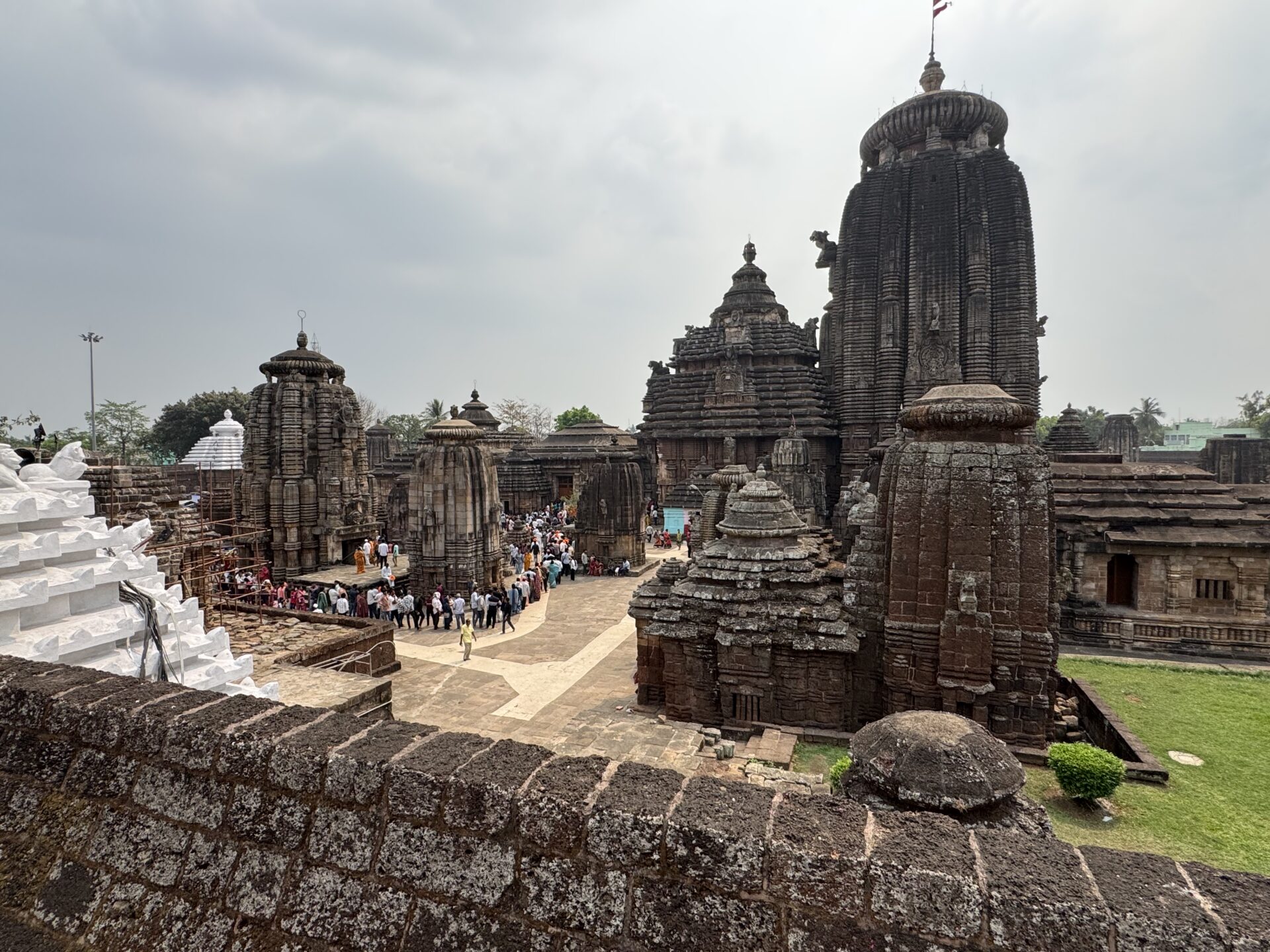
Ligaraj Temple is just a 5-minute walk from Bindu Sagar Lake. It is the most important temple in Bhubaneswar and one of the top temples in India. Expect large crowds and some chaos, and don’t expect to be allowed inside the temple unless you’re Hindu. However, there is an amazing lookout point offering a panoramic view of this beautiful temple.
I quickly realized how famous this temple was among Hindus. It was by far the busiest temple on my Bhubaneswar temple walk. There’s a vibe and anticipation that’s more like a rock concert than a religious or spiritual experience. There’s a long line to get in, with heightened security, including a police presence. The streets in front of the temple are lined with markets and food stalls, all very busy due to the large crowds.
Lingaraj Temple Architecture
The exterior of Lingaraj Temple is truly impressive, rising above Bhubaneswar with a massive spire that’s hard to miss. Built in the traditional Kalinga style, the temple is covered in detailed carvings, from gods and goddesses to intricate patterns that give it a textured, almost layered look. As you get closer, you notice how everything draws your focus toward the main tower, each layer naturally drawing your eye higher and higher. Surrounded by smaller shrines within the complex, it feels like stepping into a full stone temple city, with a strong sense of history and energy right from the outside.

Lingaraj Temple Experience and Viewpoint
If you walk around the exterior, you will see the lookout point where tourists can catch a glimpse of this stunning temple. This is when I realized how important this temple was to Hindus, as there was a large group who all wanted their own photo shoot in front of the temple. I had to patiently wait for my turn, which was totally worth it.
From the lookout point, I watched a steady line of devoted Hindus make the pilgrimage through the grounds into the main temple, with organized chants along the way. This was a truly incredible temple experience in India.
Lingaraj Temple seriously blew me away—it had to make my Top Temples in the World list. If you’re into places like this, check out the full blog here 👉 Top Temples in the World: 10 Sacred Sites I’ve Visited
And if you’re curious how these temples compare to other religious sites, I’ve also put together a list of the most impressive churches I’ve visited around the world 👉 8 Iconic Churches You Must Visit Around the Globe
Hidden Shrines and Lesser-Known Temples
What makes Bhubaneswar, maybe the top temple town or city in the world, isn’t just the extravagant, iconic temples but also hidden shrines and lesser-known temples. In the old town, there are literally hundreds of smaller, less significant temples. You don’t need a map or an itinerary. Just explore the old town, and you’ll see them. I bet you’ll pass 50, 1000-plus-year-old temples on your way back to your hotel, no joke. This is what makes Bhubaneswar so special and why it is the best temple city in the world.

Temple Rules and Etiquette in Bhubaneswar
Dress code – Modest clothing required. No shorts. Cover your shoulders.
Footwear rules – No shoes on temple grounds.
Photography restrictions – Often prohibited in sanctum areas.
Entry rules for non-Hindus -Varies by temple. The only temple in Bhubaneswar I couldn’t enter was Lingaraj.
Offerings and donation customs – Small offerings, such as flowers or sweets, are common and can be purchased near the temples. Donations are optional. Use official donation boxes and give quietly and respectfully.
Respectful behaviour guidelines – Quiet zones, be respectful of ongoing rituals.
Where to Eat in Old Town Bhubaneswar
After exploring the temples, here are a few great spots to eat around Old Town.
Biriyani Box
Perhaps my favourite Indian food is biryani. If you aren’t familiar with it, biryani is a super flavourful rice dish layered with spiced meat or veggies and cooked low and slow so everything comes together in a rich, aromatic way. It was just the right amount of spice for me.
Biriyani Box is a Bhubaneswar-based chain, and it is really good. I had the mutton biriyani twice at Biriyani Box. Mutton is meat from adult sheep. Chicken biryani is also very popular.


Baba Lingaraj Mistanna Bhandar

This was a street-food stand in front of Lingaraj Temple. I ate here for breakfast, which was an authentic Bhubaneswar breakfast, as recommended by the guest house where I was staying. The best part is the price, a whopping 50 rupees, which is about 50 cents USD. If you want a local dining experience, this is the real deal.
Old Town Café
If you are looking for Western-style food with an Indian flair, head to Old Town Café. This trendy café has an upscale vibe and a nice courtyard if you want to sit outside, right in the heart of Old Town Bhubaneswar.
I had chicken wings with tasty Indian spices and cheesy peri-peri fries. And of course, two cappuccinos, which were legit. It’s not easy to find Western-style coffee in India, so this was a nice treat for me. I went back a second time and had Alfredo with garlic bread, which was amazing too.


MeeToo Café
This is a great little spot for a chai. Order a chai tea, sit on the curb, admire the temples across the street, and reflect on your day. It’s not fancy, but I love these little hidden spots. Grab some cookies or your favourite snack and enjoy the temple view.

Food delivery app tip: Download the Zomato online food ordering app. It’s a great way to try Indian dishes from the comfort of your hotel or guest house. You’ll find restaurants from my where-to-eat list, such as Biriyani Box and Old Town Café, on the Zomato app as well.
Final Thoughts on the Top Temples in Bhubaneswar
The top temples of Old Town Bhubaneswar offer one of the most unique walking experiences in India. In just a few kilometres, you move between centuries-old shrines, intricate stone carvings, and active places of worship that remain central to daily life.
What makes this Bhubaneswar temple walk so special isn’t just the famous sites like Lingaraj Temple and Mukteshwar Temple, but the atmosphere in between — quiet backstreets lined with hidden shrines, locals gathering at Bindu Sagar Lake, and small rituals happening throughout the day.
Each temple on this route has its own character. Rajarani Temple stands out for its elegant sandstone carvings; Vaital Deula for its unusual architecture and interior; and Mukteshwar for its fine detail and early Kalinga-style design. Together, they provide a clear picture of why Bhubaneswar is known as the “Temple City of India.”
This 2–3 hour walking route is one of the best ways to experience the city. It’s compact, easy to navigate, and packed with history, culture, and everyday spiritual life.
If you’re planning a trip to India and want something beyond the usual tourist trail, this Old Town temple walk is absolutely worth adding to your itinerary.
👉Interested in visiting another one of India’s most spiritually significant temple cities? Check out my Vrindavan Travel Guide: Temples, Itinerary & Essential Travel Tips
👉To find out what goes in my backpack, check out my blog, My Carry-On Packing List for Solo Travel: How to Pack Light
Follow my travel blog
Follow me on Social Media
TikTok – for quick travel tips and shorts
Instagram – for daily updates and photos
Spotify – listen to my solo travel podcast
YouTube – subscribe for full travel videos
Globe Digger AKA Geoff Josey is a travel blogger and solo traveler from Canada. I am a former corporate executive who realized there had to be more to life than just work, running the hamster wheel, and sleep. After exploring the world for 12 months, I never returned to my old life, now with a new outlook, and I share my journey through my blog, socials, and my podcast.

Leave a Reply