
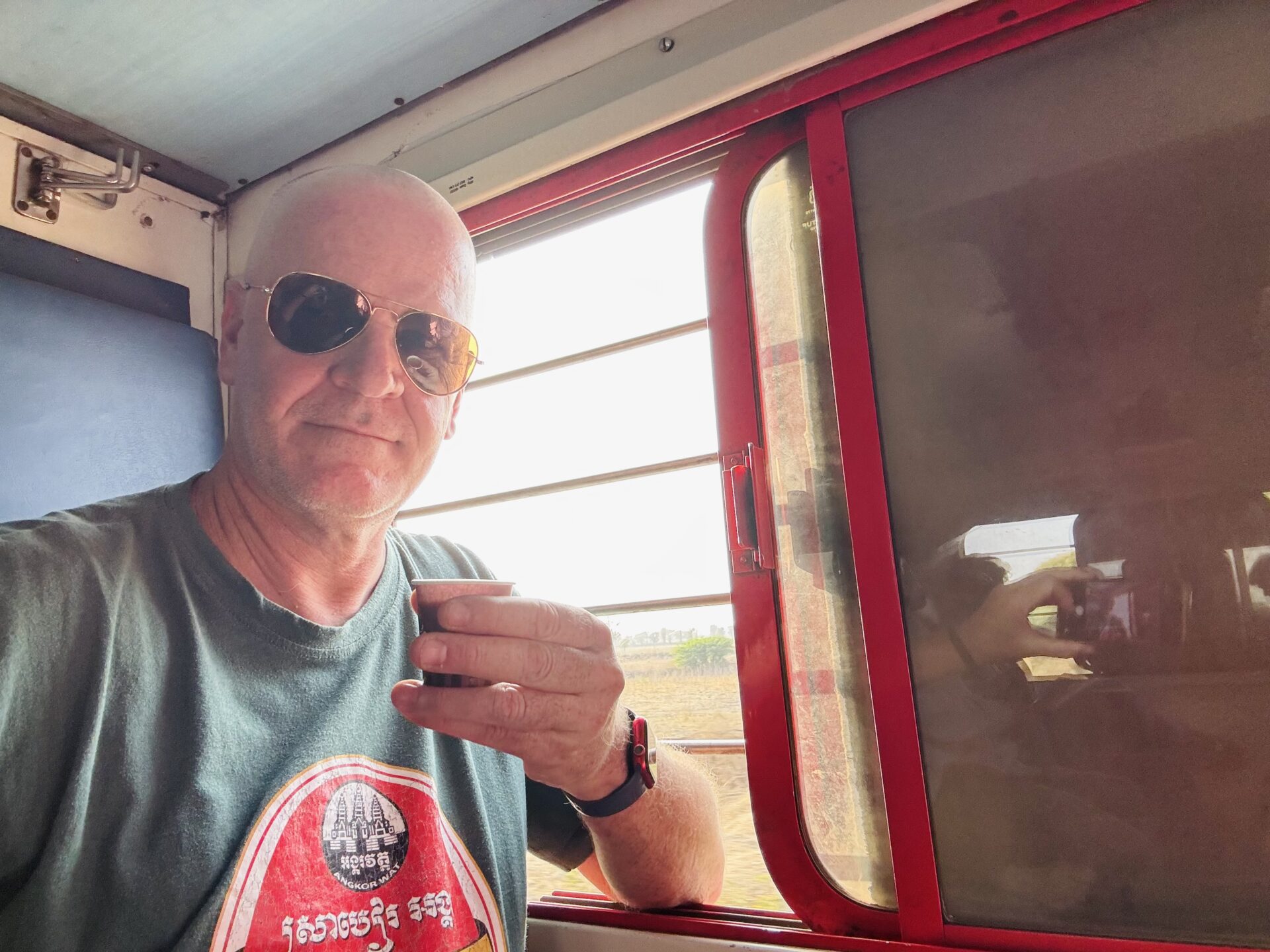
Anthony Bourdain is the biggest influence on how I travel. Discovering his award-winning show Parts Unknown changed how I saw the world and, eventually, how I travelled through it.
Bourdain inspired me to get off the beaten path, travel with minimal planning, chase the world’s best street food, seek out authentic experiences, and connect with people and cultures through food. But what really drew me in was his ability to introduce me to destinations I had never considered visiting. Watching him explore these places made me think: I can go there too.
That was the beginning of my Anthony Bourdain travel obsession and, ultimately, my desire to experience the world the way he did.
This post contains affiliate links, which means I may earn a small commission if you make a purchase through one of them at no extra cost to you. I only promote travel brands that I use myself.
Parts Unknown
Parts Unknown was my introduction to Anthony Bourdain.
What fascinated me wasn’t simply where he travelled or what he ate. He introduced me to the people, history and culture behind each destination. He wasn’t afraid to visit places many travelers might dismiss because of something they’d heard in the news or because they were considered too dangerous or too difficult.
Watching Parts Unknown made the world seem more accessible to me. Places that once felt too far to travel to suddenly became places I wanted to experience for myself. And then I discovered there was an entire Bourdain catalogue waiting for me.
No Reservations
I was so enamoured with this guy that I started watching all his previous No Reservations episodes. This was the show before Parts Unknown, and it was the Anthony Bourdain I wanted to be.
No Reservations was much more about food and travel and less about digging deep into the history and backstory of a destination. Bourdain would arrive somewhere, eat what people actually ate, drink with locals, get lost in the city, wander through markets, put himself in uncomfortable situations, and do his best to understand the culture along the way.
The vibe was unpolished. It was more like: Let’s go somewhere interesting, eat everything, and see what happens. This, my friends, is how I travel to this day.
The Layover
Then came The Layover, where Bourdain would spend 24–48 hours in a city and highlight what you should eat, drink and experience while you’re there. You’ve got 36 hours in Dublin? Here’s what you should do. You’ll see later in this blog how this episode inspired me.
The Layover also changed how I travel because I’m not interested in rushing around trying to do everything when I arrive somewhere. Instead, I want to know: What do I have to experience? What foods do I have to try? What are the local drinks? What’s one experience I’ll remember years from now?
Bourdain also taught me something incredibly simple: talk to locals. Ask where they eat. Ask what you shouldn’t miss. Ask where they’d go for a drink. For me, that’s often a much better approach than spending hours Googling “the best things to do.”
How Anthony Bourdain Changed the Way I Travel
Many of my Anthony Bourdain travel experiences over the past four years were directly inspired by places he visited. Others weren’t places he visited at all, but I experienced them through the travel philosophy he taught me.
That philosophy eventually inspired me to leave my corporate career, travel the world, and search for a greater sense of purpose.
👉 If you want to learn more about how traveling the world changed my life, check out my blog How Traveling the World Helped Me Find Purpose.
You can also read My Travel Methodology for a deeper look at how I plan my trips, get off the beaten path, and experience destinations in a way heavily influenced by Anthony Bourdain.
These are the Bourdain travel lessons that have stayed with me:
- Eat where the locals eat
- Don’t judge countries by the headlines
- Wander without a strict itinerary
- Food is the gateway to culture
- Every conversation teaches you something
- Be curious enough to become uncomfortable
These aren’t just lessons I learned from watching Anthony Bourdain on television. They’re lessons I’ve put into practice while travelling around the world.
These 10 experiences show just how much his influence shaped my journey.
Subscribe to my newsletter for more travel stories, tips, guides, and itineraries
My Anthony Bourdain Travel Experiences Around the World

“Travel isn’t always pretty. It isn’t always comfortable… But that’s okay. The journey changes you; it should change you.” — Anthony Bourdain, *No Reservations: Around the World on an Empty Stomach
1. Schwartz’s Deli – Montreal, Canada
Schwartz’s Deli was a very special experience for me for many reasons. It marked the start of my trip around the world in 2022, so it’s sentimental. My favourite hockey team, the Montreal Canadiens, plays there, and I had a ticket to see my beloved Habs before being away for at least a year. This would be the perfect send-off.
But as luck would have it, the city was essentially shut down due to COVID restrictions. This meant bare streets in the usually vibrant city and no hockey game, since fans weren’t allowed in.
So my entertainment would include walking the freezing-cold streets alone and admiring the stunning murals throughout the city. And since the restaurants were all closed, I would eat alone in my hotel room.
Hey, remember that Bourdain quote about travel not always being pretty and comfortable?

How Anthony Bourdain Inspired Me to Travel to Montreal First
Tony travelled to Montreal on No Reservations, The Layover, and Parts Unknown, and there was a theme. I remember him repeatedly saying that Montreal is Canada’s best food city and that it’s not even close. I already knew how good Montreal’s food scene was from experience, and hearing Bourdain rave about it only reinforced that it was the perfect first stop on my journey around the world. And given that I’m Canadian, where better to begin?
My Schwartz’s Deli Experience in Montreal
Since I couldn’t walk into Schwartz’s like Bourdain did, I had to resort to Uber Eats. I would have rather sat at the Schwartz’s counter, but I didn’t have a choice.
There is really only one thing to order at Schwartz’s: a smoked meat sandwich with a stack of meat like you’ve never seen before. Seriously, you can barely get your mouth around it. It literally melts in your mouth. It’s served with coleslaw, a gigantic pickle and a Cott Black Cherry soda. Make no substitutions. This is the way it has to be.
After my Schwartz’s experience, I felt fulfilled and ready to leave Montreal to begin my journey around the world. I flew to Nicaragua the next day.

📺 Bourdain Connection
The Layover — Montreal
Bourdain considered Montreal’s smoked meat one of the foods that set the city’s food scene apart.
📍 My Experience: Schwartz’s Deli in Montreal — the first food stop on my 2022 journey around the world.
🍴 What to Try: A Montreal smoked meat sandwich with coleslaw, a pickle, and a black cherry soda.
🌍 Globe Digger Tip: If it’s winter, go to a Montreal Canadiens game. The Bell Centre is one of the world’s best venues for watching a sporting event. And yes, Bourdain went to a game there on Parts Unknown and was seen wearing his Montreal Canadiens hat in future episodes.
▶️ Watch the Episode: Watch The Layover — Montreal on YouTube (availability varies by country)
2. Bangkok, Thailand
Bangkok, Thailand, holds a very special place in my heart. It was my first trip where I didn’t stay in a 5-star all-inclusive resort. It was my first real off-the-beaten-path travel experience.
For many, the main draws are exotic beaches and fancy resorts. But for me, it was the street food, the chaos, the night markets, and the crazy-ass walking streets like Khao San Road.

This was my first Anthony Bourdain travel experience, which eventually led to my journey around the world a few years later. A few things stood out to me from Bourdain’s experiences in Bangkok. He often described Bangkok as one of the world’s great street-food cities. After watching him eat his way through the city, I became convinced I didn’t need to be afraid of street food. I also remember Tony saying his crew rarely got sick from street food and joking that it was often something they ate back at the hotel that caused the problems. And let’s face it, some travelers who claim the street food made them sick are the same people who drank 20 Changs on Khao San Road the night before.
👉 Read how my first trip to Thailand inspired me to travel the world
Bangkok Adventures Inspired By Anthony Bourdain
I will never forget that first muddy water-taxi ride to the Golden Mount. I remember thinking, Wow, I feel like Anthony Bourdain. During that trip, I visited the Grand Palace, the Reclining Buddha and Wat Arun, rode the SkyTrain, ate street food, had a cocktail at SkyBar, hopped in my first tuk-tuk, and made my way to Khao San Road for a night of debauchery.
Thank you, Tony, for inspiring me to step out of my comfort zone and travel differently.

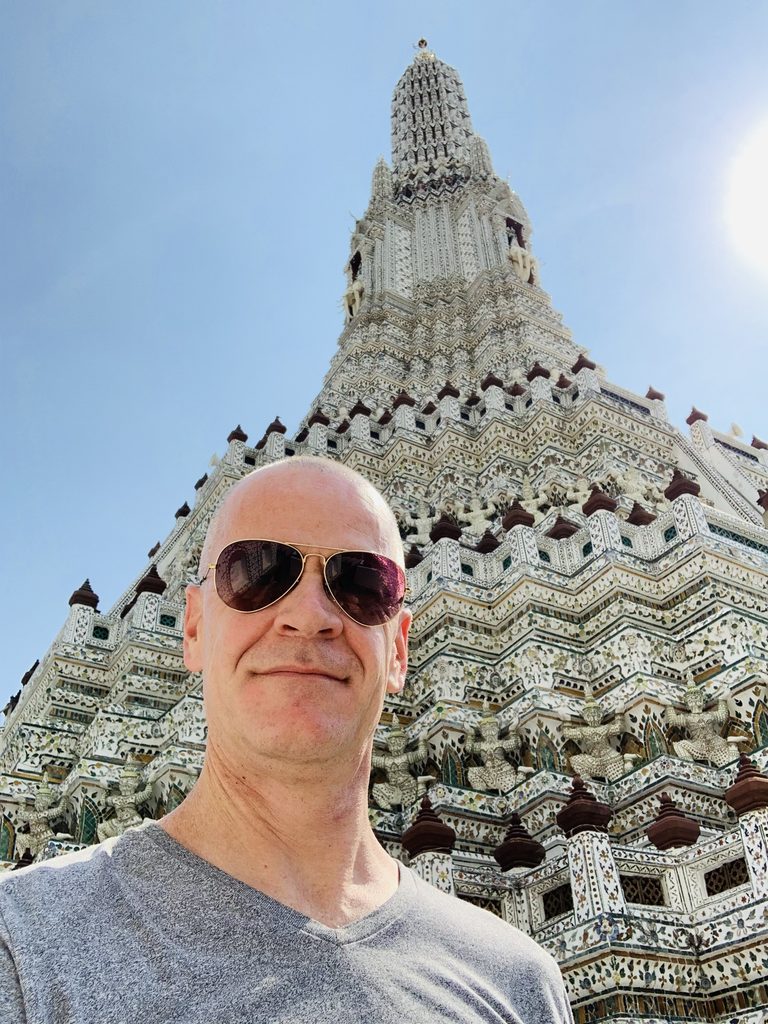
My first full day in Bangkok exploring the Grand Palace and Wat Arun
Eating in the World’s Greatest Street Food City
I will never forget my first street-food experience in Bangkok. I had arrived in the middle of the night and was amazed at how quiet a city that supposedly never slept was.
From the moment I stepped onto the street outside my hotel the next morning, it was absolute chaos. People were going about their daily lives, tuk-tuk drivers were hustling for customers, markets were coming alive, and I was trying to figure out my first Bangkok street-food experience.
👉 Looking for a place to stay in Bangkok? I stayed at the Prince Palace Hotel on my first trip and have returned on later visits. Check rates and availability at Prince Palace Hotel.
I didn’t know what to do. There were so many food stalls, everything was moving so fast, and everyone was speaking a foreign language. I was completely overwhelmed. Thoughts raced through my head: Am I going to starve to death? How am I going to read the menu? Do Thais speak English?
After walking up and down the street a few times, a vendor who clearly sensed I needed help grabbed my hand, handed me a menu with pictures of food, picked up a pail, turned it upside down, and said, “Sit.” I ordered my first Thai omelette with fresh chillies, hot sauce, rice, and a Thai coffee. I wasn’t going to starve after all. Ohhhh, this is what Bourdain was talking about.
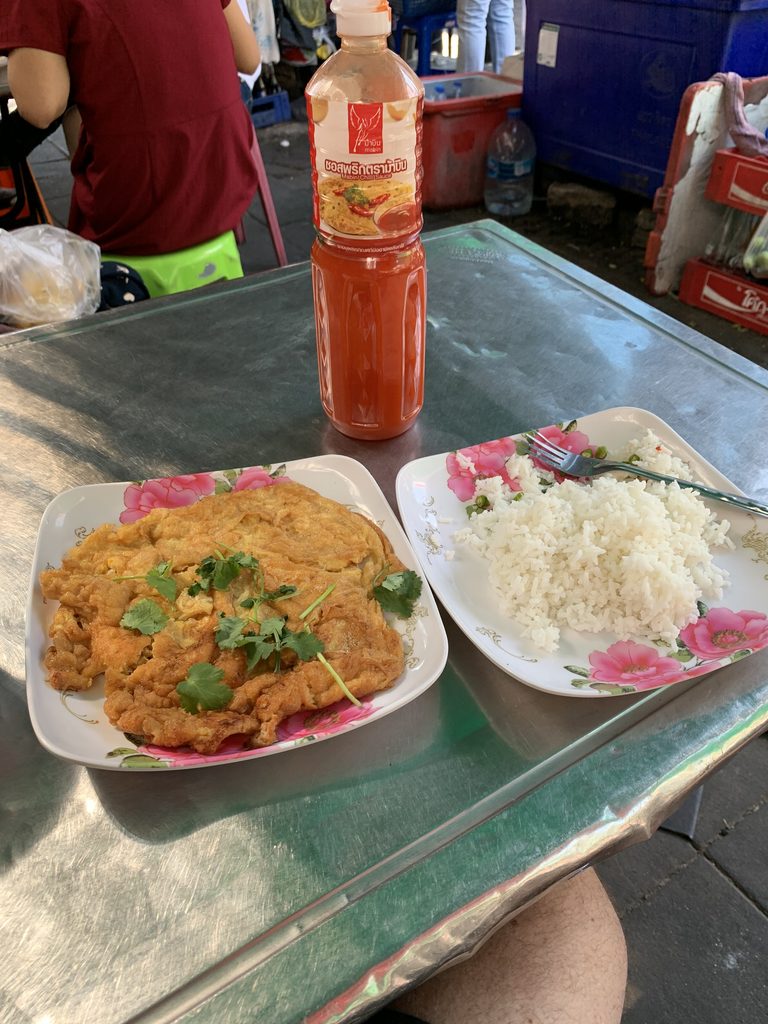
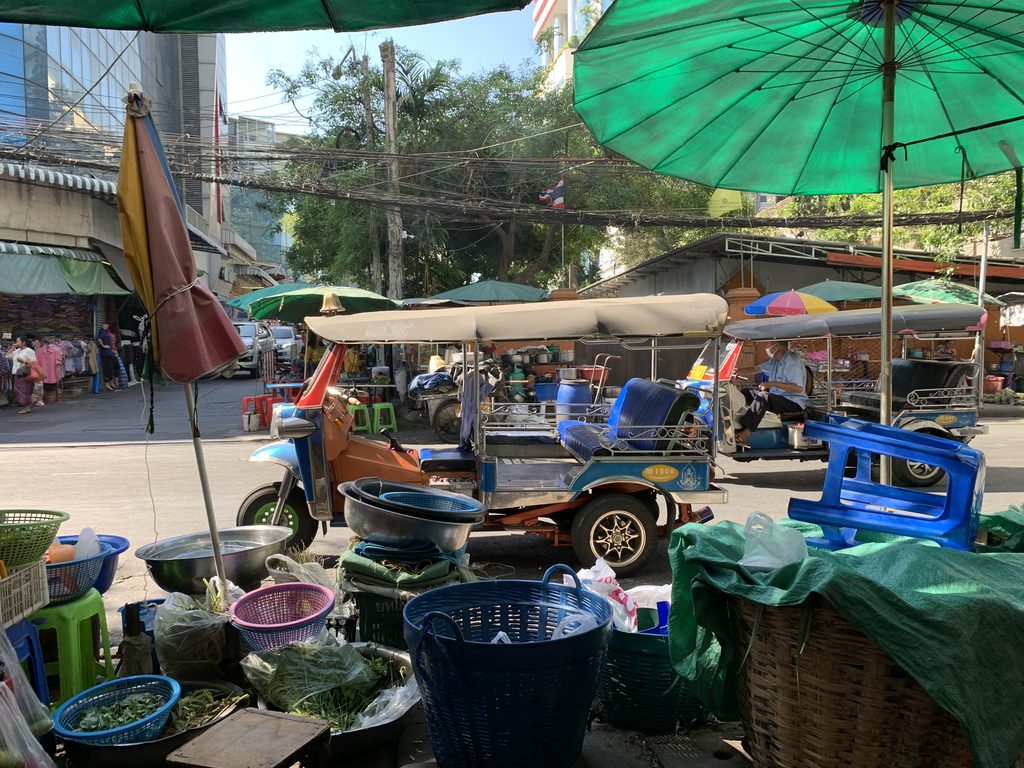
My very first meal in Bangkok was a street food experience. Yeah, you could say this was inspired by Anthony Bourdain.
👉 Check out my GetYourGuide Storefront, where I’ve brought together my favourite Bangkok experiences.
Eating My Way Through Bangkok
Some of my best food finds in Bangkok have come from night markets, Chinatown, street-food lanes, walking streets, and even Michelin-starred street food.

I remember searching far and wide on my first trip for the best pad Thai and mango sticky rice. This is something you kind of need to do on your first trip to Bangkok.
The 3 a.m. shrimp omelette I had on Khao San Road after way too many beers is another memory that stands out. If you’re ever partying in this area, I highly recommend searching out a shrimp or seafood omelette. It’s one of the best late-night drunk foods I’ve ever had.
Along the way, I’ve eaten everything from khao moo grob to pad see ew and pad kra pao. I had the famous crab omelette at Jay Fai and even tried my first scorpion on Khao San Road.
Bangkok taught me to be adventurous with food, to try things I wouldn’t normally eat, and to stop being afraid of street food. It completely changed the way I approached food while traveling.
📺 Bourdain Connection

No Reservations — Thailand and Parts Unknown — Thailand
Bourdain’s trips through Thailand reinforced Bangkok’s status as one of the world’s great street-food cities and helped give me the confidence to eat my way through the city.
📍 My Experience: I ate as much street food as I could, became more adventurous with food, and learned to get off the beaten path.
🍴 What to Try: Everything! Pad Thai, mango sticky rice and Jay Fai’s famous crab omelette are great places to start. Experiment with street food, order something you’ve never tried before, and be adventurous.
🌍 Globe Digger Tip: Take a Bangkok street-food tour early in your trip. It’s one of the best ways to learn what to eat and to discover dishes you might otherwise walk past.
👉 Want to experience Bangkok’s street food? I loved this e-scooter night tour, which took me to street-food spots and neighbourhoods I never would have found on my own. We also visited flower markets in Chinatown, Wat Arun at night, and The Grand Palace. Check out the Bangkok e-scooter food tour.
▶️ Watch the Episodes: Watch No Reservations — Thailand on Apple TV | Watch Parts Unknown — Thailand on YouTube (availability varies by country)
👉 If you’re planning a trip to Thailand but don’t have your itinerary sorted out yet, check out my Ultimate 3-Week Thailand Itinerary, which includes Bangkok.
3. Hanoi & Sapa, Vietnam
Anthony wasn’t shy about his feelings for Vietnam, often calling it his favourite country. What stood out to me was his description of the street food. I remember his narrative as finding a place on the street with tiny plastic chairs and a table, enjoying a mix of noodles or pho with a Vietnamese beer, and just soaking it in.
“Vietnam it grabs you and doesn’t let you go. Once you love it, you love it forever.” — Anthony Bourdain, World Travel
This wouldn’t be a stop where I chased down the exact locations where he ate, but rather followed his suggestions on how to travel the country. My Anthony Bourdain-inspired travel plans for Vietnam centred around Hanoi, Sapa and a stopover in Ha Long Bay.
Hanoi
Hanoi, for me, was about the food, getting off the beaten path, visiting the B52 Victory War Museum, and searching for the best egg coffee I could find. It was also an opportunity to visit nearby Ha Long Bay and Sapa.

Eating My Way Through Hanoi

This one was easy. The French Quarter, where I stayed, was filled with family-run noodle and pho shops. I didn’t go to the same place where Bourdain ate with Obama because I wanted to create my own experience using his methodology.
In Hanoi, you don’t have to plan every food stop. Just go anywhere, and there’s an excellent chance you’ll enjoy an incredible Vietnamese meal for a couple of bucks. A few of my favourites include bún-style rice vermicelli noodles, miến xào (stir-fried glass noodles with beef), chicken pho (pho ga), and, of course, bánh mì. Seriously, you need to try the banh mi in Vietnam, one of the best sandwiches in the world.
Trying My First Egg Coffee in Hanoi

Vietnam may be the most underrated coffee country in the world. Traditional Vietnamese coffee is brewed slowly through a small metal phin filter placed directly over the cup, allowing the strong, dark coffee to drip through before it is mixed with sweetened condensed milk or enjoyed black.
But what really sets Vietnamese coffee apart is egg coffee. Egg yolks are whipped with sweetened condensed milk until thick and creamy, then spooned over strong Vietnamese coffee, creating an almost custard-like layer on top. It’s hard to imagine, but you just have to try it. One of the most famous places to try it in Hanoi is Café Giang. I found the world’s best egg coffee. Well, that’s my story, and I’m sticking to it.
Visiting Nearby Ha Long Bay
I also visited nearby Ha Long Bay, which took me down another Bourdain memory lane. I remember his episode about how tourism had transformed the area and the lives of the people who traditionally lived and worked on the water.
Ha Long Bay is one of those places you have to see to believe, with thousands of massive islands rising from the emerald-green water as you cruise through one of Vietnam’s most spectacular landscapes.
The other adventure I did from Hanoi was a two-day trip to Sapa.

👉 If you are interested in a two-day Ha Long Bay cruise from Hanoi, check out Ha Long Bay cruise options from Hanoi.
👉 I booked both my Ha Long Bay and Sapa tours through Luxury Backpackers in Hanoi. It’s an amazing hostel with an incredible tour desk. Check rates and availability at Luxury Backpackers.
Sapa
I took my first overnight bus from Hanoi to Sapa. Sapa is where you go to experience a completely different side of Vietnam, trekking through mountains and rice terraces, visiting tiny villages, and staying with local families, far from the chaos of Hanoi.

👉 I use 12Go to book my transportation across Southeast Asia. If you are looking to book an overnight bus from Hanoi to Sapa, check schedules and book tickets on 12Go.
This was an experience I will never forget, and it was pouring rain. I remember arriving, and the bus driver had to wake me up. I looked around and realized I was the last one on the bus, so I got off, and a guy was waiting for me on a motorbike. Half asleep, I jumped on the bike and made my way to my guesthouse for a few hours of shut-eye before my epic Sapa hike.
In the morning, our guide met us at the guesthouse. She would be our guide for the next two days, and we would eventually stay with her family in her village. We set out into the Sapa mountains in the pouring rain, passing through small rural villages, rivers with strong currents, rice fields, and some of the most amazing landscapes of my life, even with the rainy clouds.
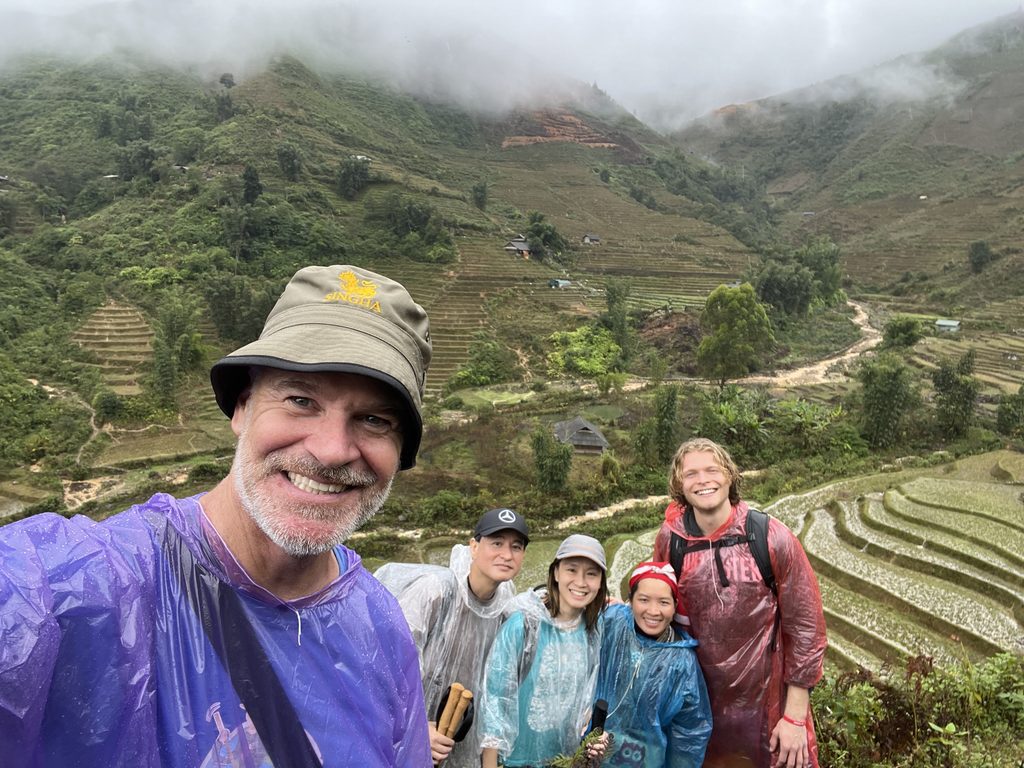

Taking a time-out for a selfie and walking around a rice field.
👉 Check out my GetYourGuide Storefront, where I’ve brought together my favourite Hanoi experiences, including Sapa and Ha Long Bay.
A Lunch Stop at A local Village
We had an incredible lunch in one of the villages, with a killer backdrop of rice fields and beautiful landscapes. Lunch was a huge plate of stir-fried noodles with egg, cabbage and pork. It was simple, filling and exactly what I needed after hiking through the mountains.
After another few hours of hiking through villages and bamboo forests, dodging wandering buffalo, we finally arrived at our guesthouse for the night.
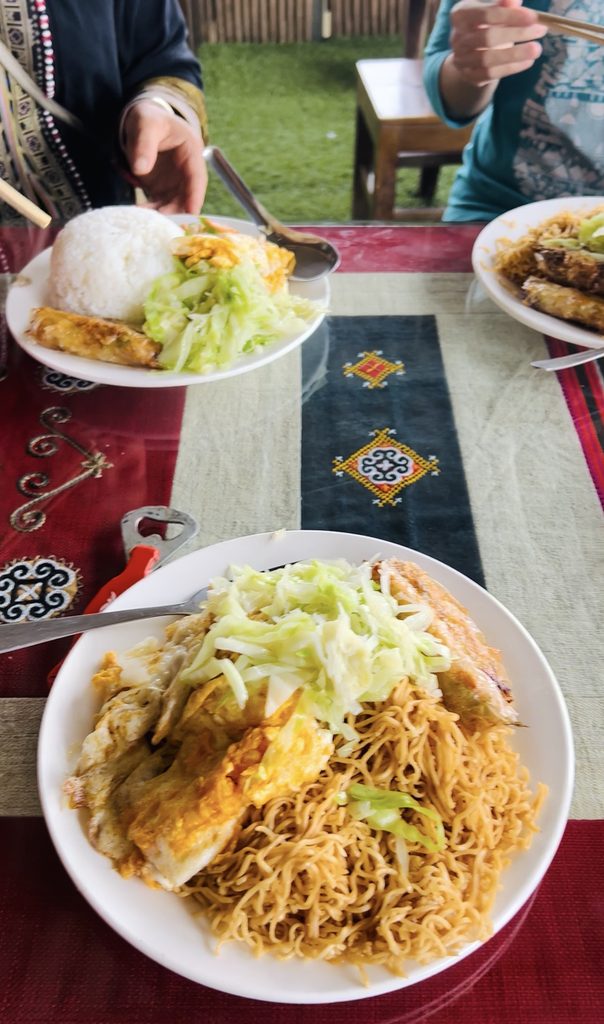
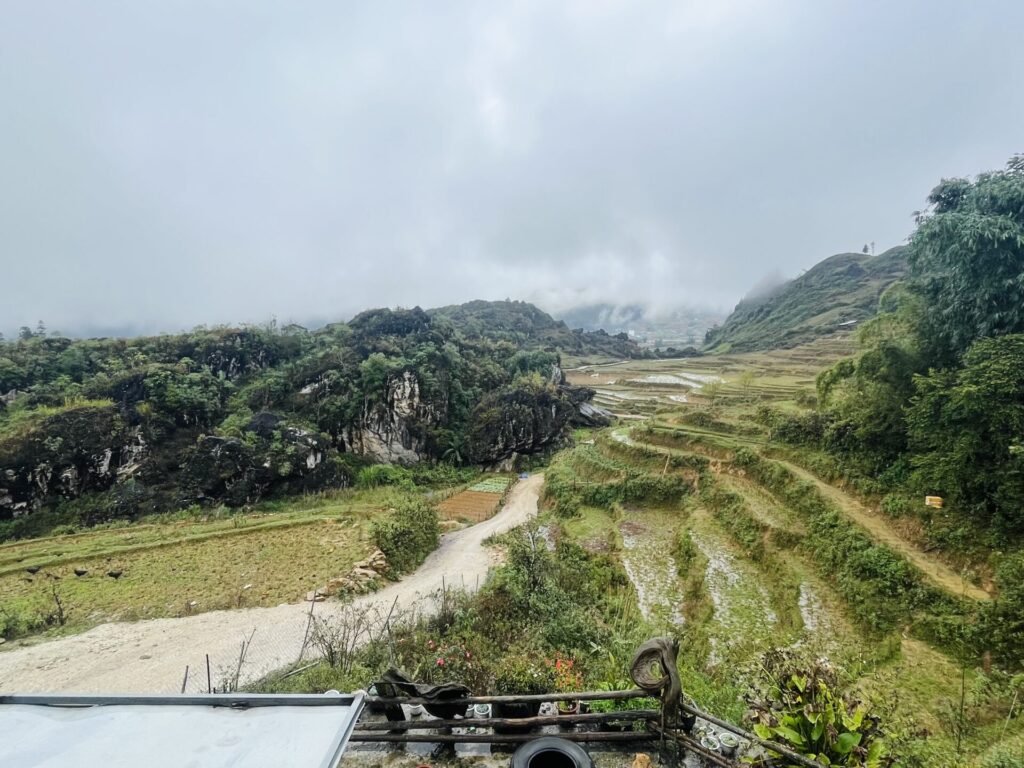
How about this for a lunch view in the Sapa mountains?
Prepared Dinner and Met The Family
This was starting to feel like an episode of Parts Unknown. I had just hiked into the mountains of Sapa and was about to spend the evening with a local family in Ta Phin, a village near Sapa known for its Red Dao community. We would spend the evening preparing a traditional meal, learning about the culture, talking politics and drinking way too much rice wine.
Our host also explained the significance of traditional clothing and headwear in her community, noting that a woman’s headdress, rather than a wedding band, indicates her marital status.
When we arrived, the kids were riding their bikes through the house on the unfinished floors, and there was a fire pit in the middle of the family room. The husband was preparing slop for the pigs on the other side of the room.
Our host immediately put me to work, teaching me how to make spring rolls. There is nothing quite like homemade spring rolls cooked over an open fire in the middle of a room.

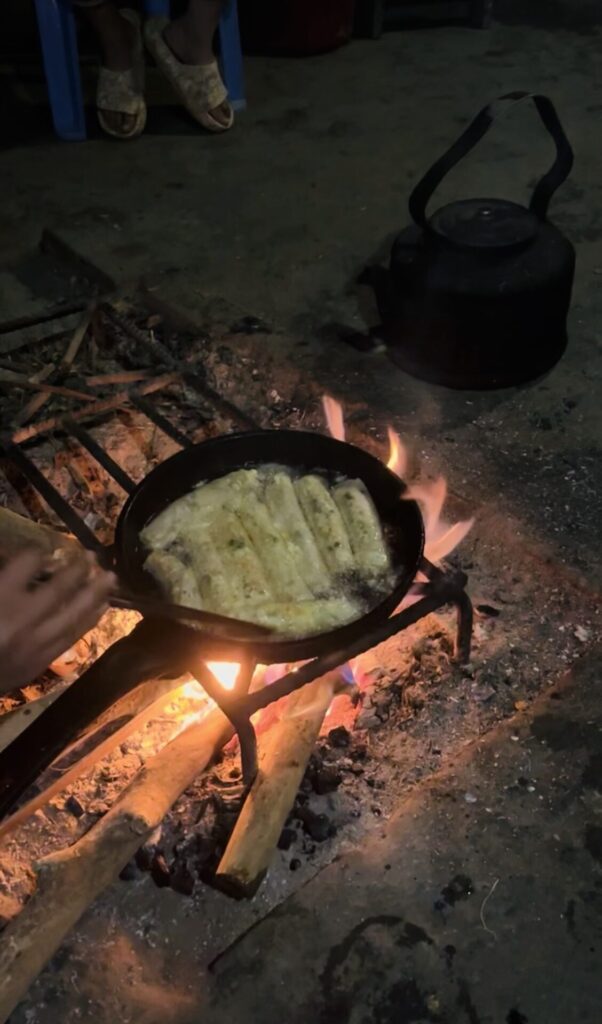
Left: My host’s husband preparing slop for the pigs. Right: The fire pit used for heat and cooking in the middle of the living room.
There was another traveler staying with the family, Jesper, who happened to be a professional football player playing in Munich. The World Cup was underway, and he had some free time, so he decided to spend it trekking through Vietnam. After a couple of Vietnamese beers, we were ready for dinner. I was starving.
We Shared a Traditional Meal Together… And Rice Wine

Dinner at my homestay in Sapa was served family-style, with an incredible spread of chicken, pork, fresh vegetables, spring rolls and rice. We talked about politics, local customs, the community and neighbouring China, whose border was not far from where we were staying. At one point, I referred to the Vietnam War, and my host quickly corrected me: “The American invasion.”
That stopped me in my tracks. It was history I had known my entire life, suddenly described from the perspective of someone who grew up on the other side of it. Bourdain was right: one of the best ways to learn about a culture and connect with people is to share a meal.
There was another moment over dinner when I realized how deep into Vietnam I was. I was wearing a Rolling Stones T-shirt, and the host asked why it had a tongue on it. I said, “It’s the Rolling Stones.” She said, “Who are they?” Excuse me? So I played Paint It Black on my iPhone, a song that has become heavily associated with the Vietnam War through Western movies and television. “Yes, I know this song,” she replied, “but in Vietnamese.”
Then came the homemade rice wine, which my host called happy water. Lots of homemade rice wine. It’s really rice whisky, and sharing it together was a big part of our evening. In the village, it’s customary to drink rice wine with guests, and the host wasn’t going to shut it down until we’d had enough. We drank shot after shot after shot. Let’s just say sleeping would not be a problem for me after this.
A Traditional Red Dao Herbal Bath
Ta Phin is particularly known for the herbal bathing traditions of the Red Dao community. Before bed, our host prepared a traditional herbal bath with fresh local herbs. So Jesper and I stripped down to nothing and jumped into the barrels. What an end to a perfect day in Sapa.
The Next Morning
Before making our way back, we had pancakes with syrup, tropical fruit, and instant Vietnamese coffee for breakfast.
The sun finally came out, giving us some clear-sky photos. Along the way, we stopped at our host’s friend’s place, which was a full house, with kids running around and everyone eating. It was a feast: sautéed pork, chayote squash, stir-fried cabbage, tofu with tomato, fresh local herbs, fish sauce, and rice. Another absolutely incredible meal. We eventually returned to the guesthouse, took a motorbike to the bus, and headed back to Hanoi.
📺 Bourdain Connection
No Reservations / Parts Unknown — Vietnam
Bourdain’s love for Vietnam went far beyond individual restaurants. His shows introduced me to a way of experiencing the country through street food, shared meals, local people, and everyday life — exactly what I wanted to experience for myself.
📍 My Experience: Eating my way through Hanoi, exploring Ha Long Bay, trekking through the mountains of Sapa, and sharing meals, conversation, and plenty of rice wine with a local family.
🍴 What to Try: Pho, bánh mì, bún noodles, egg coffee, Vietnamese beer, and, if you’re invited to share, homemade rice wine.
🌍 Globe Digger Tip: Don’t experience northern Vietnam through Hanoi alone. Spend a few days in the city eating everything you can, but make time to head into the countryside. An overnight trek and homestay in Sapa was one of my most memorable experiences in Vietnam.
▶️ Watch the Episodes: Watch No Reservations — Vietnam on Apple TV | Watch Parts Unknown — Vietnam on YouTube (availability varies by country)
👉 If you’re headed to Vietnam, check out my 2-Week Vietnam Itinerary
👉 Want to experience Sapa with a local family? Check out two-day Sapa hikes with homestays.
4. Dublin, Ireland
Following Anthony Bourdain Through Dublin’s Historic Pubs
Everything in Dublin centres around its pub culture and, well, Guinness. Okay, maybe not everything, but almost everything. That was just fine with me, as I love Guinness and I love pubs — two of my favourite things in life.
My time in Dublin felt like my own version of No Reservations. A local couple I had met while sailing across the Caribbean to Colombia offered to show me around for the week, giving me the chance to experience Dublin with people who actually lived there.
Pubs, the Guinness Storehouse and Hurling
In Dublin, I visited two pubs Anthony had gone to: John Kavanagh’s The Gravediggers and Slattery’s.
A few other iconic pubs I visited included The Confession Box, The Brazen Head, Frank Ryan’s Bar, Phil Ryan’s “The Hogan Stand,” and The Cobblestone. Sorry, no Temple Bar — but I did walk past it. Apparently, locals avoid the Temple Bar area because it’s too touristy and very expensive.

I was also lucky enough to attend a hurling match at Croke Park. Hurling is a traditional Gaelic sport played primarily in Ireland, and it’s hard to describe, but it’s like a combination of hockey, lacrosse and rugby. And of course, I visited the Guinness Storehouse, where we spent the better part of a day learning about Ireland’s most famous beer and drinking a few pints.
But one Dublin experience stood above the rest.
The Gravediggers – A Bourdain Favourite
You can’t visit Dublin without stopping by John Kavanagh’s The Gravediggers. I remember Bourdain describing it as one of the world’s best watering holes. After all the iconic bars this guy visited around the world, you knew The Gravediggers had to be epic. And it was.
The Gravediggers opened in 1833 beside the original entrance to Glasnevin Cemetery and became the local watering hole for mourners and the men who dug the graves. The pub shared a wall with the cemetery, and legend has it that thirsty gravediggers would knock on the wall with their shovels to order a pint — one knock for one, two knocks for two. Over time, John Kavanagh’s became affectionately known as The Gravediggers.
That connection to the cemetery remains today, with mourners and visitors to Glasnevin still stopping in for a pint after paying their respects. It’s a tradition that has connected the pub to the cemetery next door for nearly two centuries.


I Started The Evening With A Guinness Stew
I met my friends at the pub’s main entrance, and I was excited to try the coddle, which Anthony had hyped up and made sound soooo good.
But when I sat down with my friends, they talked me out of it, saying it was bland and that I would hate it. Okay then, that’s not what I heard on No Reservations. Bourdain described the coddle as a hearty stew of sausage, bacon, onion and potatoes slowly simmered in broth. It sounded pretty good to me, but I went with the Guinness stew anyway. That’s still a solid Irish meal at an iconic Irish pub, right? It really was incredible, especially after washing it down with some Guinness.
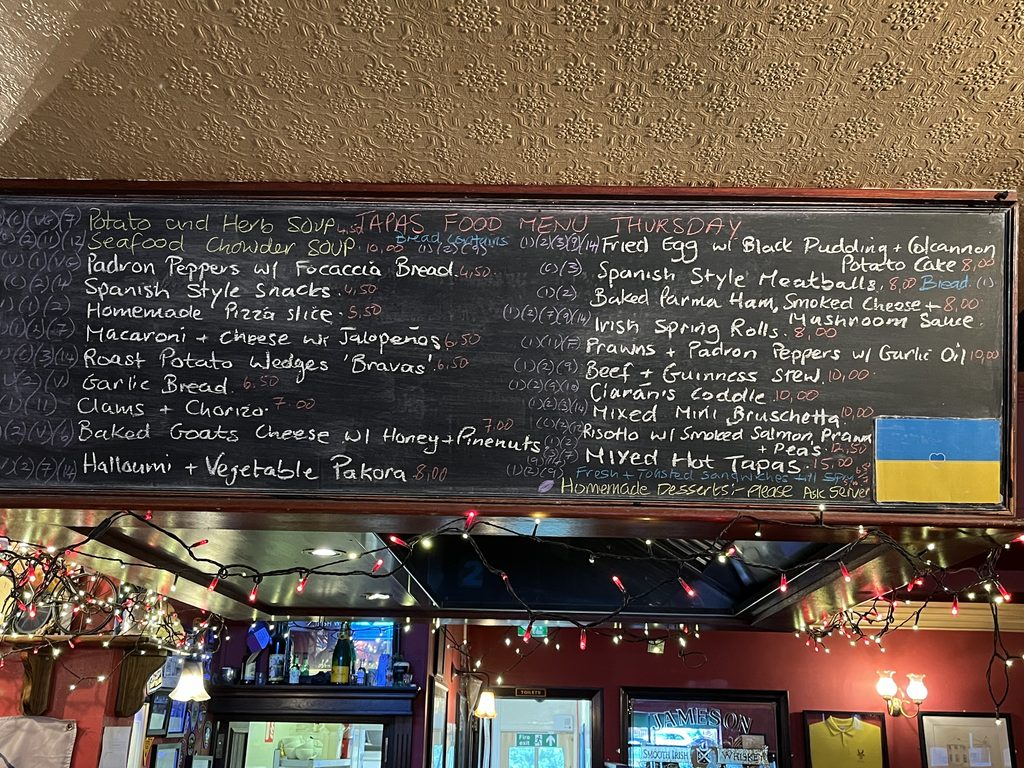
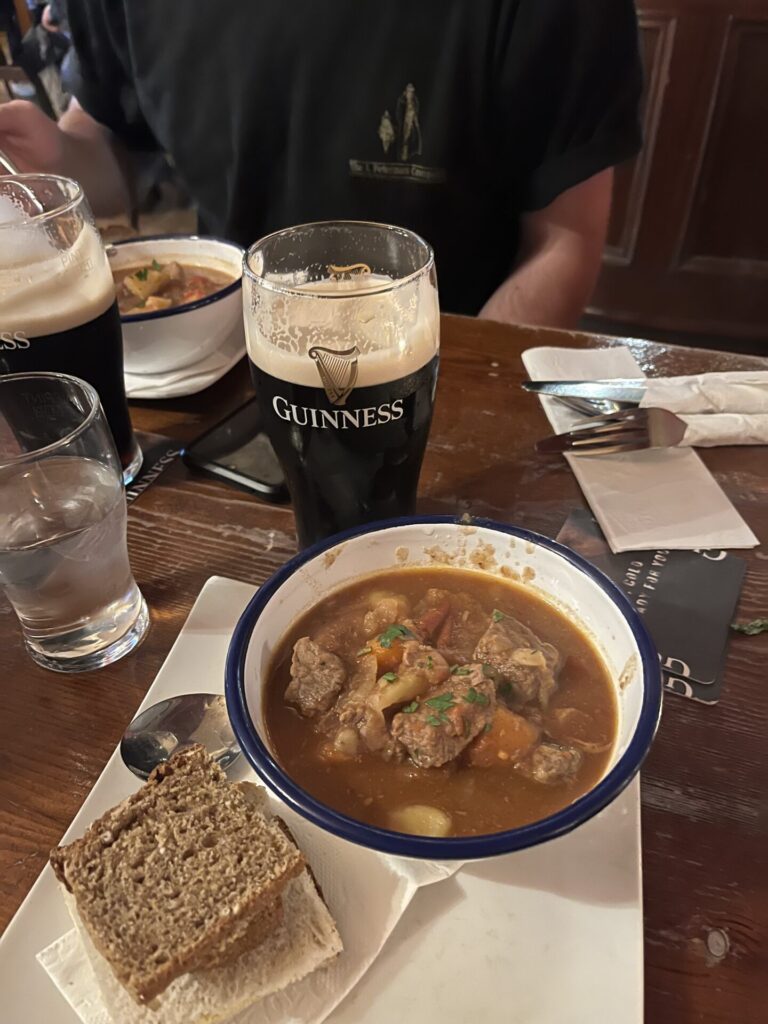
Left: The Gravediggers food menu, including the Anthony Bourdain travel classic Ciarans Coddle, which he had here on No Reservations. Right: I had the Guinness stew with the natural drink pairing – A Guinness.
20-Plus Pints of Guinness At The Gravediggers
We made our way over to the main pub for the evening. If you’re a Guinness lover, The Gravediggers arguably serves up one of the best pints in Ireland. I have never seen so much Guinness flow in my life. It’s like a river of Guinness. I didn’t see anything else being served — just Guinness. Lots of it.
Apparently, one of the secrets to a great Guinness is taps that are constantly flowing, and for the record, by the end of the night I counted 24 pints of Guinness. But hey, after 10, who’s counting, right?
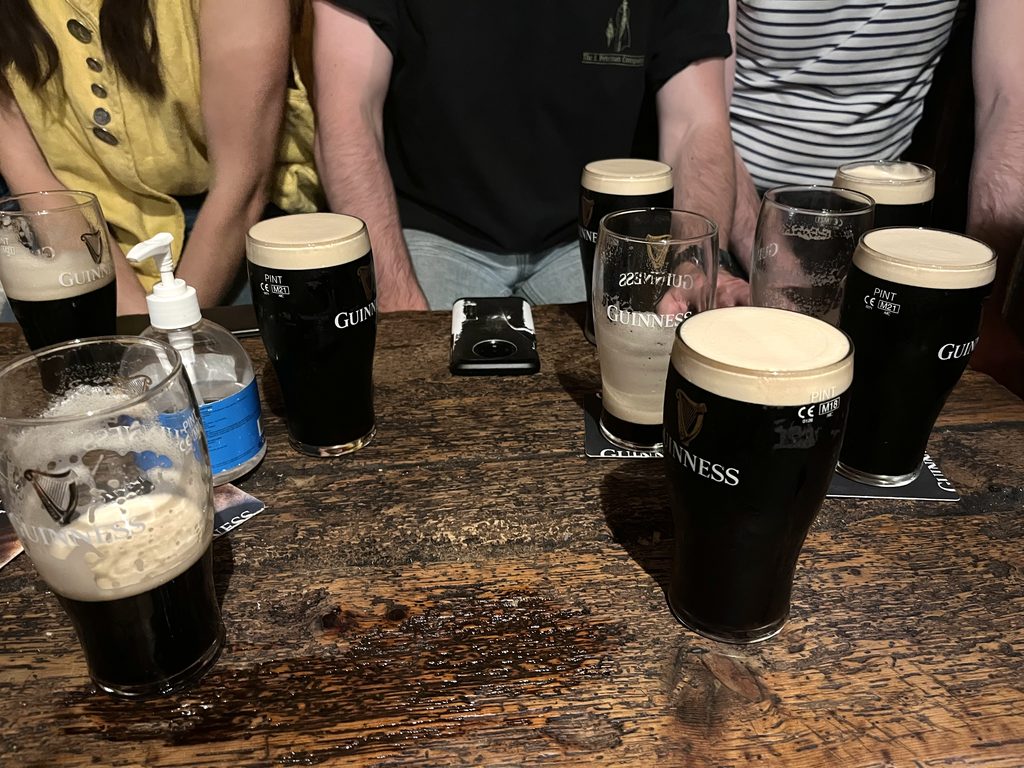

👉 Check out my Gravediggers Instagram Video
The Gravediggers is a traditional pub that has stayed true to its roots. To this day, it’s built around conversation rather than entertainment. No TVs. No music. Just people talking over a Guinness. All you hear is chatter. Imagine that — people still talking to each other.
As the night went on, I sat with a dozen or so Dubliners, talking politics and culture and listening to old Dublin pub stories. After a few Guinness, they would argue over who was more Irish. And they say there’s no entertainment in this pub?
This would go down as one of the best pub nights of my life.

A selfie with my friends from Dublin, who were the best tour guides. My Dublin experience wouldn’t have been the same without them.
Hangover Breakfast At Slattery’s

After 24 pints of Guinness, there was only one thing left to do the next morning: follow in Bourdain’s footsteps to find a proper Dublin hangover breakfast.
He was famous in my mind for his hangover cures, so breakfast at Slattery’s was perfect. I arrived around 10 a.m., and only a few people were in the bar. They were probably waiting for someone to get the taps going and order that first pint of Guinness. But for me, it was time to dig in.
There was nothing fancy about this breakfast, and that was fine with me. Sausages, bacon, black and white pudding, fried egg, hash brown, grilled tomatoes, and toast were piled onto one plate with a strong cup of coffee. This was old-school Dublin pub food, exactly what I needed.

📺 Bourdain Connection
No Reservations — Ireland and The Layover — Dublin
Bourdain’s visits to Dublin introduced me to the city’s old-school pub culture, particularly The Gravediggers and Slattery’s.
📍 My Experience:
Exploring Dublin’s pubs with local friends, drinking an absolutely ridiculous amount of Guinness at The Gravediggers, and recovering the next morning with a traditional Irish breakfast at Slattery’s.
🍴 What to Try:
Guinness, Dublin coddle, Guinness stew, and a traditional Irish breakfast.
🌍 Globe Digger Tip:
Skip the tourist pub crawl around Temple Bar and explore some of Dublin’s traditional neighbourhood pubs. Better yet, talk to Dubliners and ask where they drink.
▶️ Watch the Episode: Watch The Layover — Dublin on Apple TV
👉 Looking for a place to stay in Dublin? I stayed at Generator Dublin. It has an amazing restaurant and bar, comfortable beds, and a very modern feel. It’s located in the old Jameson building and close to some iconic Dublin pubs. Check rates and availability at Generator Dublin.
👉 Want to explore Dublin’s pub scene? I took a pub tour that brought me to many of the pubs mentioned above. Check out Dublin pub tours on GetYourGuide.
5. Brazil — Rio de Janeiro & Salvador
Anthony Bourdain inspired me to travel to Brazil, and his narrative was spot on.
I remember his description of the caipirinha as one of the world’s great cocktails and his claim that the best place to enjoy one was on Rio’s beaches. He called it pure bliss, so of course I added it to my bucket list.
The other Brazil episode that stayed with me was Salvador. There is a narrative that Salvador is too dangerous for tourists, and there may be some truth to it. But what Bourdain said about safety in Brazil stuck with me. To those afraid to visit Salvador, he said:
“Live your life, man. You should not miss a place like this because there aren’t a lot of places in the world that even come close to this.” — Anthony Bourdain, World Travel
That was it. I was sold on Salvador, Brazil, and I knew I would one day make this dream a reality. There is no way I would have ever visited Salvador without this man’s influence.
Rio de Janeiro
I’m starting with Rio because I spent more time there than anywhere else on my trip around the world. Sometimes, when travelling, you just fall in love with a city, and Rio was one of those places. I spent three weeks there. I loved the vibe, the nightlife, the beaches, the football-fanatic culture, the favelas, and, of course, the food.
A few highlights included the Two Brothers hike, visits to the favelas, Copacabana Beach, a Flamengo football match, a night out at Pedra do Sal, the Selarón Steps, and, of course, Christ the Redeemer.

👉 Want to hike Two Brothers? Check out guided Two Brothers hike options on GetYourGuide.
👉 Want to experience a Flamengo match in Rio? Check out Flamengo football experiences on GetYourGuide.
Having A Caipirinha On Copacabana Beach
My first beach day at Copacabana was going to be epic. When the server approached and asked if I’d like a drink, I knew exactly what I was going to order. Bourdain’s favourite cocktail: the caipirinha.
He was not wrong. This is the perfect beach cocktail. Cachaça, muddled lime, sugar, and ice. That’s it. I even got a temporary Rio tattoo from a beach vendor because, apparently, I was now in full-on Bourdain mode. This was one of the best beach days of my life.

Galeto Sat’s: A Late-Night Bourdain Stop
Galeto Sat’s was a restaurant Bourdain visited in the early morning hours after many drinks in Rio. So I had to do the same.
I found a restaurant, grabbed a table on the street, ordered a bucket of Antarctica beers and some Brazilian churrasco, and had one hell of a night. I made friends, we drank together, but as the night wound down, we went our separate ways. For me, that meant making the 40-minute walk to Galeto Sat’s for some late-night eats.
Eating Anthony Bourdain’s Meal At Galeto Sat’s

The walk to Galeto Sat’s didn’t sober me up much, and I had the munchies, which was probably a good thing. This time, I wasn’t just travelling by Bourdain’s philosophy. I was actually going somewhere he had eaten.
When I arrived, I told the waiter that Anthony Bourdain was the reason I was there. He looked at me and said something like, “If you want, I can bring you exactly what Bourdain ordered.” I didn’t need to look at a menu after that.
A little while later, the food started arriving. And arriving. And arriving. The centrepiece was the spicy galeto — a small, juicy Brazilian chicken, roasted over charcoal and chopped into pieces. Then came rice, egg farofa, molho à campanha, an enormous plate of French fries, and, of course, a cold Brazilian beer.
Metal plates. Simple tables. Chicken hacked into pieces. Food everywhere. A cold beer sitting beside it. I looked at the amount of food spread across the table and asked the waiter: “Did he eat all of this?” Seriously, there was enough food here to feed five people.

The more I watched his shows and read about his travels, the more I realized that these massive spreads were very much part of the Bourdain experience. Rather than ordering one dish, there would often be a table full of food.
So there I was in Rio de Janeiro, staring down this ridiculous amount of food and attempting to eat the same meal the waiter said had been served to Anthony Bourdain. I had travelled halfway around the world, walked into a restaurant Anthony Bourdain had visited, and ate the same thing. This time, I wasn’t just travelling like Anthony Bourdain. I was eating his dinner.
Salvador: Just Follow the Drums
I had made it to Salvador, Brazil. This would be a journey about finding the best acarajé, drink more caipirinhas, and experience an almost festival-like atmosphere every night. What stood out to me in Bourdain’s Salvador episode was the nightlife. I remember his advice was simple: just follow the drums. And this couldn’t have been more true.
From the moment you arrive, you can hear drums throughout the historic district. In the early evening, they guide you to Largo do Pelourinho, surrounded by colourful colonial buildings in the heart of Salvador’s historic centre, or, as Bourdain described Salvador, “the heart of the heart of Brazil.”
Percussion groups march through the cobblestone streets and squares, filling Salvador’s historic Afro-Brazilian neighbourhoods with music. You don’t necessarily need a plan in Salvador. You just follow the sound of the drums. Every night I was there, this was the vibe, and I loved it. There was a group of us who had met at the hostel, and we would just wander the cobblestone streets together every night.

Acarajé, Moqueca and More Caipirinhas
Every night in Salvador starts with a caipirinha happy hour. Well, it did for me, at least. I was lucky because my hostel, Hostel Galeria 13, hosted one every night from 4 to 6. It was the perfect start to a night out in Salvador.
Maybe the best part was that the hostel cost me about $10 USD per night. It was in a perfect location in the historic district, had a free caipirinha happy hour, and served one of the best free hostel breakfasts I had during my travels.
👉 Looking for a place to stay in Salvador? Check rates and availability at Hostel Galeria 13.
In Search of the Best Acarajé
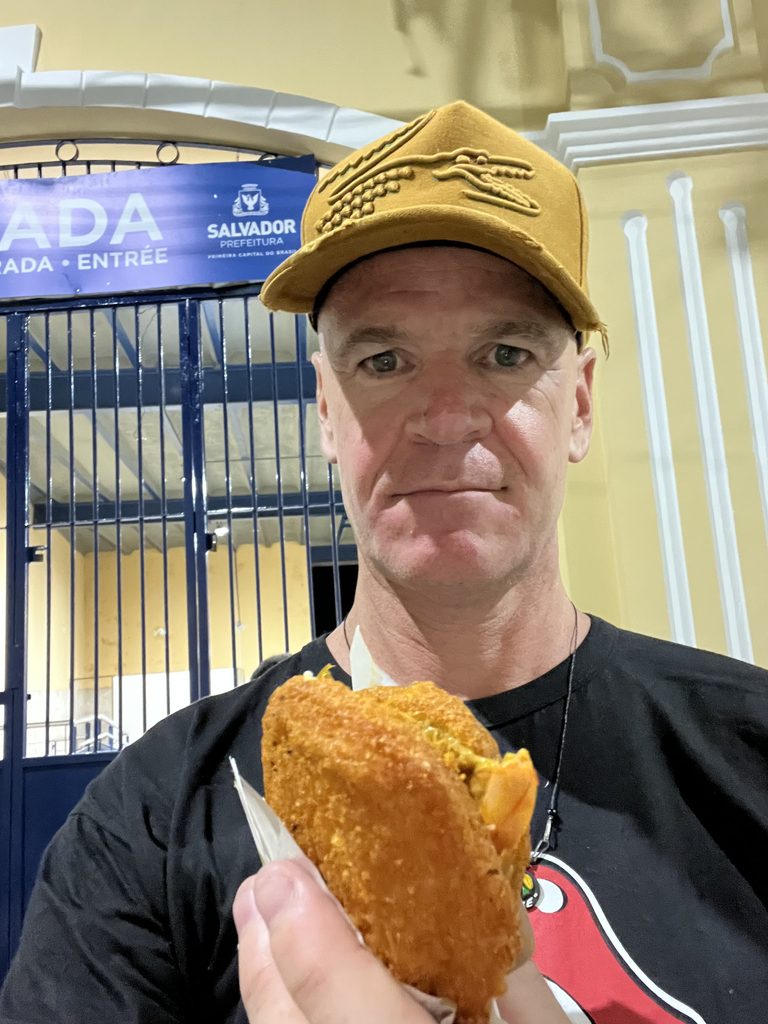
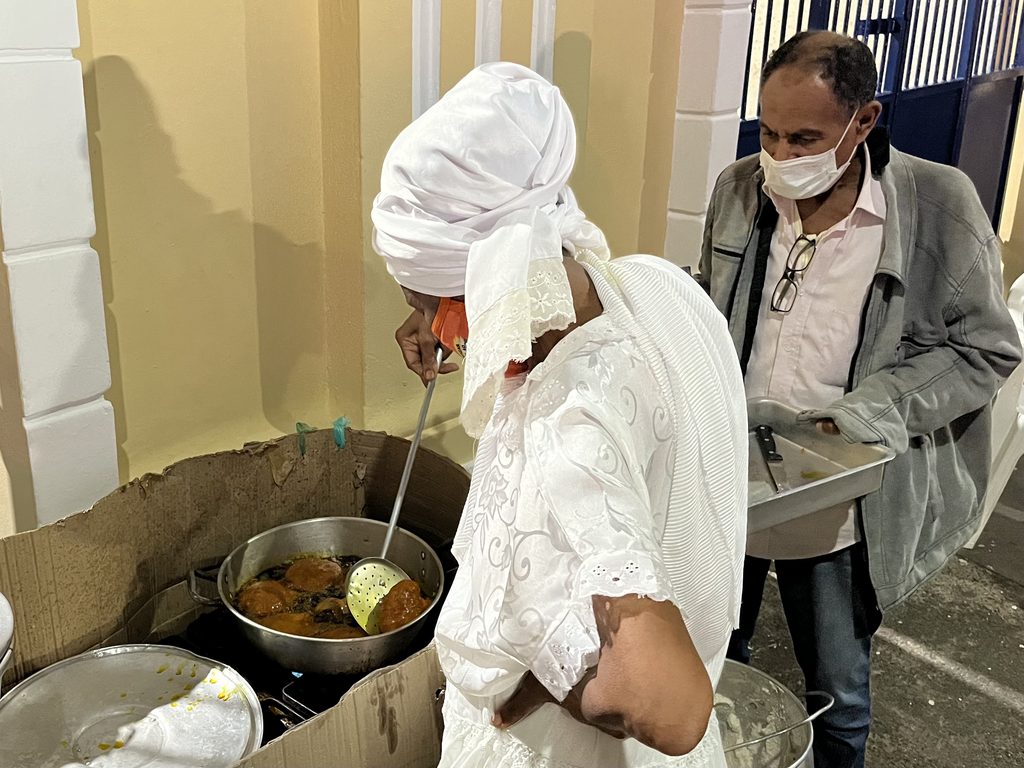
It wouldn’t be a true Anthony Bourdain Salvador travel experience without searching for the best acarajé. Acarajé is a deep-fried black-eyed pea fritter, sliced open and loaded with spicy shrimp, creamy vatapá and vegetables. It’s fried in dendê palm oil, which gives it its distinctive flavour and colour. It’s messy, spicy and absolutely delicious.

Acarajé has deep West African roots and became an important part of Afro-Brazilian food culture in Bahia. Salvador was one of the major ports of entry for enslaved Africans brought to colonial Brazil, and Bourdain explored how that history continues to shape the city’s culture and cuisine.
I was out with my new friends from the hostel when we met a local who offered to show us around for the night. This was my chance, so I asked him where to find the best acarajé in Salvador. He told me it wasn’t at the popular tourist restaurants around the main square; it was on the street. He said the local women selling acarajé outside their homes did it best.
We walked over to his favourite spot, and I ordered my first acarajé. I remember this was all she was selling. When you do one thing well, you know it’s going to be great. She was dressed in traditional clothing with a head covering and cooked the acarajé right there in a massive pot of dendê oil, then loaded it with the spicy shrimp filling.
I found it. I ate it. I loved it.
It was worth the search, and my trip to Salvador was complete. Or so I thought. Then I discovered a dish that Bourdain hadn’t sent me looking for — and I loved it even more.
Moqueca: My Favourite Meal in Salvador
When I talked to locals, it wasn’t acarajé they kept telling me I had to try before leaving Salvador. It was moqueca.
I asked the staff at my hostel where I should go for the best moqueca. They sent me hiking up one of Salvador’s massive hills to Di Janela, a little neighbourhood restaurant with tables spilling onto the cobblestone street.

When the moqueca arrived, it was still bubbling in the dish — shrimp swimming in a rich mixture of coconut milk, tomatoes, peppers, herbs, and dendê palm oil, served with rice, farofa, and pirão. This was one of the best meals I’ve had during my travels around the world. People often ask me about the best foods I’ve eaten while travelling, and moqueca is always in my top three.

And this is exactly what Bourdain taught me to do. Don’t Google “best restaurants in Salvador.” Ask someone who lives there where to eat, then go wherever they send you.
Fun fact: Before Di Janela became a restaurant, it was the owners’ home and a regular gathering spot for friends. Because the front door required walking around the corner, friends started taking a shortcut and climbing through the window for food and drinks. The owners joked that their house had become a “window bar,” and when they eventually opened the restaurant, the joke inspired the name Di Janela — a playful take on the Portuguese word janela, meaning “window.”
📺 Bourdain Connection
No Reservations — Rio and Parts Unknown — Bahia, Brazil
Bourdain inspired me to experience two very different sides of Brazil — drinking caipirinhas on the beaches of Rio and eating his late-night meal at Galeto Sat’s, then traveling to Salvador to experience the Afro-Brazilian culture, food and nightlife he loved.
📍 My Experience: Three weeks in Rio, followed by Salvador, where I followed the drums through Pelourinho, searched the streets for acarajé, and discovered one of my favourite foods in the world, moqueca.
🍴 What to Try: In Rio, enjoy a caipirinha on Copacabana Beach and try the spicy galeto at Galeto Sat’s. In Salvador, don’t leave without trying acarajé and moqueca.
🌍 Globe Digger Tip: Don’t overplan Salvador. Wander through Pelourinho, follow the sound of the drums, and ask locals where to eat. That’s how I found some of my favourite experiences in the city.
▶️ Watch the Episodes: Watch No Reservations — Rio on Apple TV | Watch Parts Unknown — Bahia, Brazil on YouTube (availability varies by country)
6. Angkor Wat, Cambodia
Angkor Wat is one of the wonders of the world. Well, I don’t think it actually is. Until recently, I truly believed it was because it’s an indescribable experience. Let me put it this way: it’s one of my Wonders of the World, a place that stops you in your tracks the moment you lay eyes on it.
The Place That Couldn’t Be Captured in a Photograph
Anthony put it best when he said Angkor Wat was the place where he stopped taking photographs because no picture could do it justice. He was right; it’s one of those places in the world you have to experience to fully appreciate its beauty and significance.

I also remembered Bourdain talking about the food stalls around Angkor Wat, so I had to do the same. I grabbed lunch and an Angkor Beer, sat down within sight of the temples, and had my own little Anthony Bourdain travel moment.
How I Visited the Angkor Temples
I chose to explore the Angkor temples by tuk-tuk, a Bourdain suggestion. I booked through my hotel, Antonios Villa Hotel, for $20. We set off at about 3:30 a.m. to pick up a day pass and visit Angkor Wat for sunrise.
If you do one thing here, make it the Angkor Wat sunrise. Watching the sun rise over the temple is breathtaking.

We stopped for breakfast before visiting Angkor Thom, Ta Prohm, and Ta Keo. You may recognize some of these temples from movies such as Lara Croft: Tomb Raider and First They Killed My Father. Ta Prohm is especially memorable for the massive trees with exposed roots growing through and around the temple.
After another afternoon visit to Angkor Wat, which looked completely different than it did at sunrise, we headed to Phnom Bakheng for an epic mountain sunset before heading back to my hotel.
👉 Looking for a place to stay in Siem Reap? Check rates and availability at Antonios Villa Hotel.
👉 Check out my GetYourGuide Storefront, where I’ve brought together my favourite Siem Reap experiences, including Angkor Wat tours, all in one place.

Eating in Siem Reap
It’s not a true Anthony Bourdain travel stop without talking about the food.
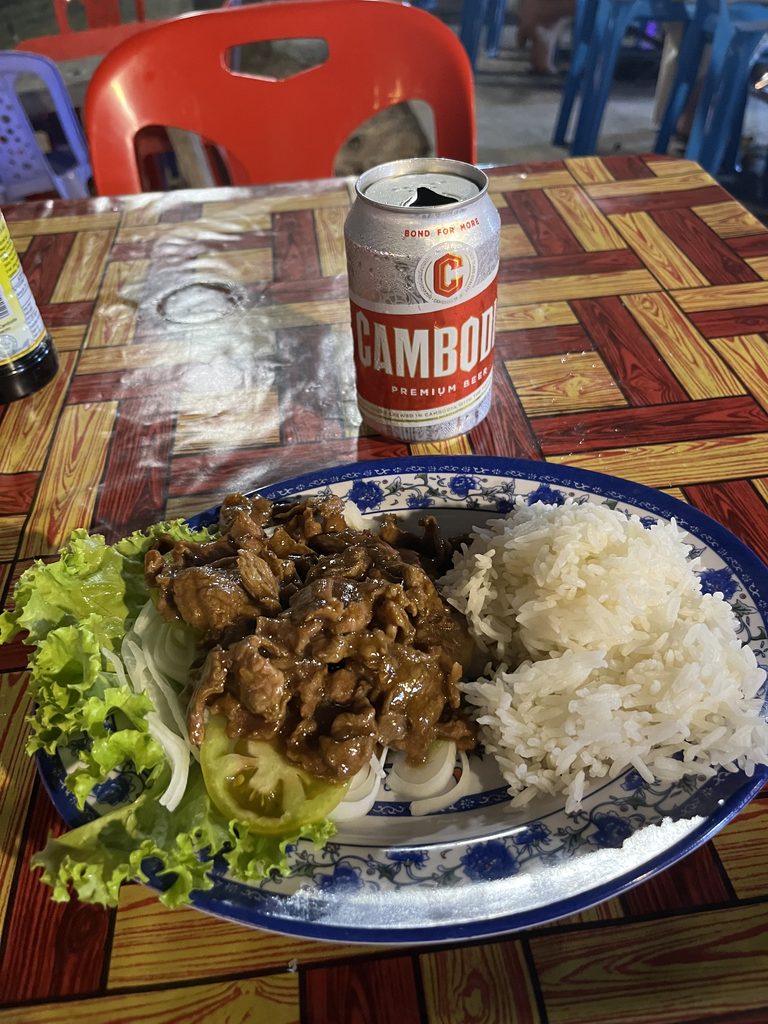
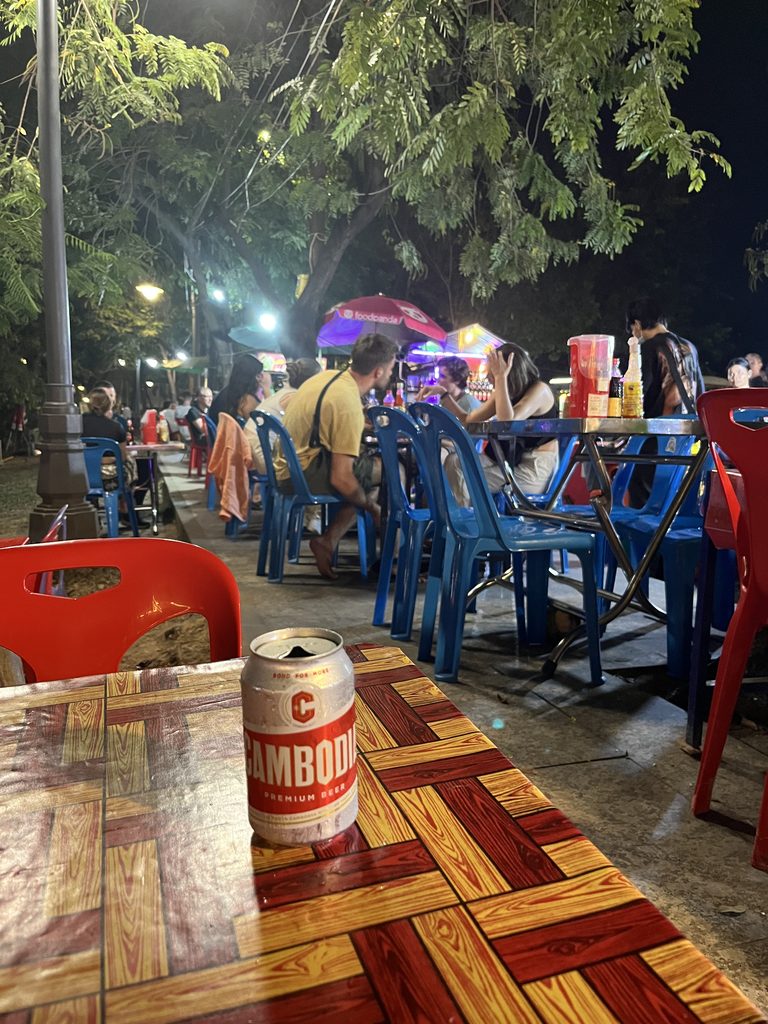
After spending the day exploring the Angkor Temples, I ended up at a simple roadside food stall in Siem Reap, with plastic chairs, a plate of Cambodian beef lok lak, and a cold Cambodia Beer. The beef was incredibly spicy and served with rice, onions, lettuce, and tomato. Nothing fancy, and that was exactly the point. This was the kind of meal Bourdain had taught me to look for — local food, a cold beer, and a place where local people actually eat.
Cambodia’s Darker History
Bourdain also didn’t shy away from Cambodia’s dark history under the Khmer Rouge. Between 1975 and 1979, nearly two million Cambodians died from executions, starvation, disease and forced labour. The Killing Fields weren’t just one place but sites across the country where thousands were executed and buried in mass graves.
While Bourdain explored this history in Phnom Penh, I experienced that darker side of Cambodia at the Wat Thmey Killing Fields memorial in Siem Reap. It was a sobering contrast to the beauty of Angkor Wat and a reminder that to truly understand Cambodia, you also have to understand what its people endured.
👉 If you are planning a trip to Siem Reap and need help with your itinerary, check out my 4-day Cambodia itinerary blog.
📺 Bourdain Connection
No Reservations — Cambodia
Angkor Wat was one of the places Bourdain visited during his travels in Cambodia. What stuck with me was his belief that photographs couldn’t adequately capture the experience and his willingness to explore both Cambodia’s incredible beauty and its darker history.
📍 My Experience:
Sunrise at Angkor Wat, followed by a full day of exploring Angkor Thom, Ta Prohm and Ta Keo by tuk-tuk, ending with sunset at Phnom Bakheng.
🍴 What to Try:
Cambodian beef lok lak from a local food stall, paired with a cold Cambodia Beer.
🌍 Globe Digger Tip:
Get up for the 3:30 a.m. tuk-tuk ride. Yes, it’s ridiculously early, but watching the sun rise over Angkor Wat is one of those travel experiences that’s absolutely worth losing sleep over.
▶️ Watch the Episode: Watch No Reservations — Cambodia on Apple TV
7. India
My seven-week journey took me across India, from Mumbai and Goa through Mount Abu, Udaipur, and Jaipur in Rajasthan, north to Amritsar in Punjab, then through Delhi, Agra, and Vrindavan before continuing east to Kolkata and Bhubaneswar. Much of the journey was by train, which became as much a part of my experience in India as the destinations themselves.

Following Anthony Bourdain Beyond the Tourist Trail
Bourdain traveled through Mumbai, Punjab and Rajasthan during his time in India. India may be one of the easiest countries in the world to travel like Anthony Bourdain. It’s pretty much impossible to escape the organized chaos, incredible street food, connections with locals and some of the most iconic adventures you’ll find anywhere.
For this blog, I’m going to focus on my experience in Mount Abu. I could easily have included Amritsar, Mumbai, Delhi, Goa, Kolkata, Jaipur and Udaipur, but this is a blog, not a book.
Mount Abu, Rajasthan
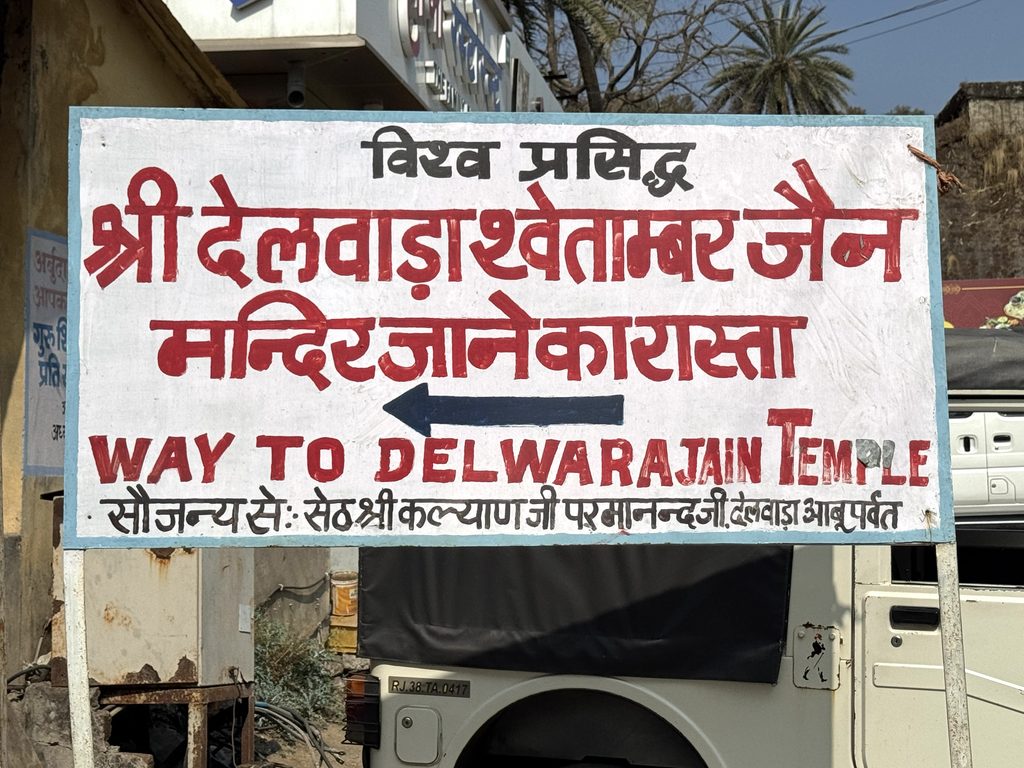
Tony’s episode in Mount Abu inspired me to travel to India. He visited the Dilwara Jain Temples in a place I’m sure no one had ever heard of. There he was in India, in the middle of nowhere, visiting temples associated with a religion I had never even heard of and eating a vegetarian meal in a local’s house. And he loved it.
That said a lot for a notorious meat eater who, before this meal, hadn’t spoken highly of vegetarian cuisine. That was it. One day, I was going to visit Mount Abu in India and do my best to recreate this experience.
Travelers Don’t Go to Mount Abu
I was staying at a hostel in Udaipur when I told the manager I was heading to Mount Abu. She said, “What? No one goes to Mount Abu.” Well, I do, and so does Anthony Bourdain!
As it turned out, I don’t recall seeing a single Western tourist in Mount Abu, so she was right. The next challenge was how to get there.
Getting to Mount Abu
I flew from Goa to Udaipur because Mount Abu doesn’t have an airport. There was one bus per day from Udaipur to Mount Abu, but it was cancelled, so I was in a jam.
My only option was a taxi, which cost $40 USD and took about 2.5 hours. My driver picked me up from my hostel on a motorbike and then took me to the taxi. There were actually two drivers. They told me that driving back at night could be dangerous in certain areas, so the second driver came along as a wingman.

It was an adventurous drive along winding, hilly roads, with monkeys and lots to look at. We stopped at a rest stop to share snacks and a drink, then made our way to Mount Abu, Rajasthan’s only hill station in the Aravalli mountain range.
👉 If you’d like to avoid the hassle and book a Mount Abu tour from Udaipur that includes the Dilwara Temples, check out Mount Abu tour options on GetYourGuide.
The Dilwara Jain Temples
The next morning, I began my journey to the Dilwara Jain Temples. It was about a 30-minute walk from my hotel, which was centrally located between the temples and the city centre. Along the way, I passed remote villages, smaller temples and lakes, and stopped for chai and breakfast at a café. I sat with some locals, shared my story, and got to know them a bit before continuing toward the temples.
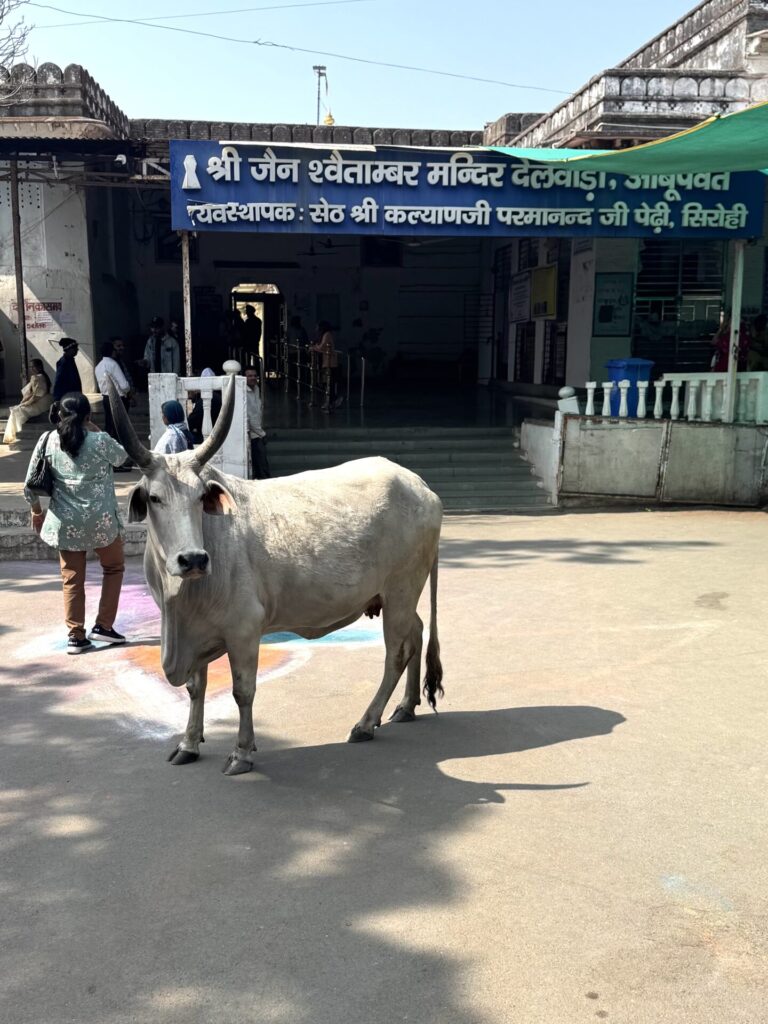
I arrived via a remote village, and at first glance, I couldn’t believe I had finally made it. There were dozens of monkeys, a few well-fed cows, and the top of the temple visible in the distance. The feeling was surreal.

Pav Bhaji for Lunch
I was starving, so before visiting the temples I stopped for lunch at a local restaurant called Jay Ambey Restaurant. It was a mom-and-pop shop, and I even stopped to talk with some temple worshippers and posed for a few pics.

I had Pav bhaji, a big plate of spicy, buttery mashed vegetables served with soft bread rolls toasted in even more butter. Tear off some pav, scoop up the bhaji, add some onion and a squeeze of lime, and you’re good to go.
Maybe it wasn’t the exact vegetarian meal Bourdain had in Mount Abu, but sitting near the temples and eating a plate of local vegetarian food felt like my own version of the experience.

👉 Check out my Pav Bhaji Instagram video from Jay Ambey Restaurant in Mount Abu.
Wandering Through the Dilwara Jain Temples Neighbourhood
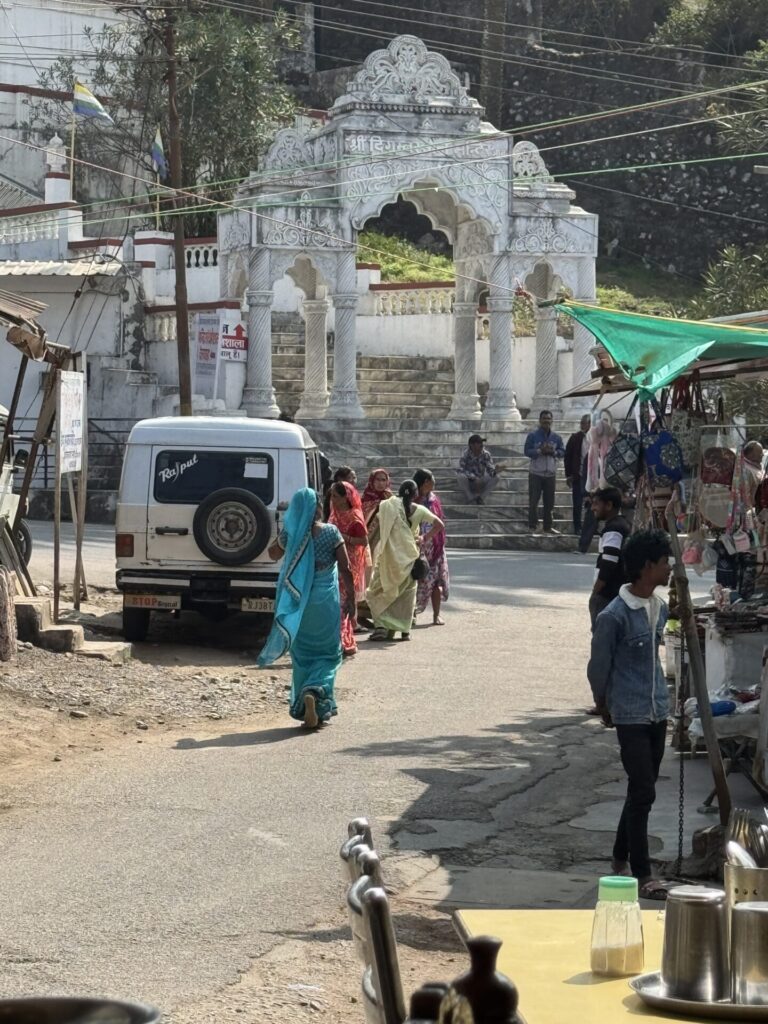
I remember Bourdain commenting on the neighbourhood and how it was one of his favourites. And I totally get it. The architecture of the white buildings, the small shops and the temples give the neighbourhood a completely different feel. It didn’t seem designed around international tourism. I was wandering through a neighbourhood built around everyday Indian life centered around the iconic temples. If you are searching for an authentic Indian experience, visit this neighbourhood,.

Going Inside the Dilwara Jain Temples
My first attempt to enter the temple was a failure. They have a no-phone rule, so I had to check that. The second issue was that I was wearing shorts, so I had to go to a local shop and buy some long pants. This mission was a success, so after removing my shoes and socks, I was allowed in.
Walking into the Dilwara Jain Temples is one of those moments when you aren’t prepared for what you’re about to see. From the outside, the temples are surprisingly modest, with simple white-marble exteriors.
Then you step inside. The marble carvings are unbelievable — white rosettes cover the ceilings, figures are carved into the pillars, and enormous domes are covered in detail that seems almost impossible to carve by hand. With the cool marble floors, soft light filtering through the temples, and almost complete silence, it was one of the most peaceful experiences I had in India.
👉 Check out my blog, Top Temples in the World, that features the Dilwara Jain Temples
Eating My Way Through Mount Abu
The food in Mount Abu was different from what I had in other parts of India. I had my first lassi, tandoori chicken, masala corn, and a bread omelette, but one of my favourite food memories came from a group of kids I met at Sunset Point. They insisted I try the Maggi noodles because, according to them, they were different from Maggi elsewhere in India. Who was I to argue?
Maggi is a favourite mountain snack in India, and in Mount Abu you’ll find little roadside stalls putting their own spin on it with extra masala, vegetables, butter, cheese, and spices. There’s something about eating a steaming bowl of spicy Maggi in the cool mountain air that just hits different.


I also tried masala corn from a street stall at the base of Sunset Point. Hot, sweet corn tossed with butter, chilli, chaat masala and lime – spicy, tangy and ridiculously addictive. Check out my masala corn Instagram video from Mount Abu.
And I finished the night with a thick, creamy lassi from a street vendor. After working my way through Mount Abu’s spicy street food, it was the perfect way to end the night.
What About the Rest of India?
I could easily keep going. Amritsar alone gave me the Golden Temple, Langar Hall, and some incredible street food. Jaipur was another stop that could have made this blog.
But this is exactly why I chose Mount Abu for this blog. Of all the places I visited during my seven weeks in India, this was the one Bourdain had put in my head years earlier.
👉 Check out my Amritsar travel guide, where I share my Punjab adventure in detail.
👉 Check out my Jaipur Tuk-Tuk Tour with a local guide, exploring palaces and hidden gems of the Pink City.
📺 Bourdain Connection
No Reservations — India: Rajasthan
Anthony Bourdain’s visit to Mount Abu and the Dilwara Jain Temples was one of the experiences that first inspired me to travel to India. Watching a notorious meat eater embrace a vegetarian meal in a local home while exploring a place far outside the typical Western tourist trail captured exactly what I loved about the way he traveled.
📍 My Experience:
I traveled from Udaipur into the Aravalli Mountains to Mount Abu, walked through local villages to the Dilwara Jain Temples, and spent my time exploring the neighbourhoods and eating my way through the local street-food scene.
🍴 What to Try:
Pav bhaji, spicy Mount Abu-style Maggi, masala corn, and a cold lassi.
🌍 Globe Digger Tip:
Don’t come to Mount Abu expecting a destination built around Western tourism. That’s part of what makes it special. Take your time, walk the neighbourhoods, stop for chai, eat at street stalls, and talk to people along the way.
▶️ Watch the Episode: Watch No Reservations — India: Rajasthan on Apple TV
8. Lima, Peru
My Anthony Bourdain travel experience in Lima would centre around the food, with one dish in particular that captured my attention when he talked about it: ceviche.
I was travelling through Nicaragua when I first tried ceviche. I loved it, but my friend who introduced me to it told me I had to try ceviche in Peru. No one does it better than they do. I remembered the Parts Unknown episode in Lima where Bourdain had ceviche, and as luck would have it, I would be visiting Peru in a few months.
So I had two food missions in Lima: find some great ceviche and track down the famous picarones stand featured in Netflix’s Street Food: Latin America.
Finding Ceviche at Mercado Central
Ceviche is one of Peru’s signature dishes — fresh raw fish cured in lime juice and mixed with red onion, chilli and cilantro, usually served with Peruvian corn and sweet potato. It’s fresh, acidic, spicy, and one of those foods you simply have to try in Lima.

I headed to Mercado Central and found a small cevichería, where I ordered two Peruvian classics: ceviche and jalea de mariscos. The ceviche was everything I had hoped for, while the jalea was the complete opposite — a massive pile of crispy fried seafood topped with crunchy plantain chips.
Sitting in a busy local market with two enormous plates of food in front of me was exactly the kind of experience Bourdain had taught me to seek out.
I came to Peru dreaming of Machu Picchu, but Lima was already teaching me that some of the best travel experiences happen around a table.

Picarones Mary: Lima’s Famous Doughnut Stand
When I checked into Pariwana Hostel Lima, one of the first things they told me was to visit Picarones Mary, just up the street. They reminded me that it had been featured on Street Food: Latin America, so it was a no-brainer.

Picarones Mary isn’t a fancy dessert shop or restaurant. It’s a legendary little street-food stand in Parque Kennedy, in the heart of Miraflores, where locals line up for freshly fried picarones. There’s something very Lima about standing in the park, watching them drop the dough into hot oil, then eating them outside while they’re still warm and covered in sweet syrup. They were melt-in-your-mouth amazing, worth the wait and every penny.
I stayed at Pariwana Hostel in Miraflores. It’s centrally located, with a kick-ass rooftop, excellent food, a bar, and a tour desk to help you plan the rest of your trip through Peru.
Lima was my introduction to how diverse Peruvian cuisine is. Beyond ceviche and picarones, I tried everything from cuy (roasted guinea pig) to fresh churros and Peru’s famous Pisco Sour.
Lima wasn’t only about eating. I wandered through local markets, explored the historic centre, and walked along the Miraflores cliffs overlooking the Pacific Ocean. But when I think about Bourdain and Lima, it’s the food I remember most.
Want to explore more of Lima? Check out my complete Lima itinerary, including the markets, neighbourhoods, food, and some of my favourite experiences in the city.
👉 Explore Lima with a local: I recommend a GuruWalk walking tour to experience the historic centre and discover some of the places and foods that make the city so amazing.
👉 Check out my GetYourGuide Storefront, where I’ve brought together my favourite Lima experiences.
📺 Bourdain Connection
Parts Unknown — Peru
Bourdain’s travels through Peru put the country’s incredible food culture on my radar, but it was the ceviche that stuck with me. By the time I arrived in Lima, eating ceviche in Peru had become one of those Bourdain-inspired travel experiences I needed to have.
📍 My Experience:
I headed into Mercado Central for ceviche and jalea de mariscos, tracked down Picarones Mary in Miraflores, and spent the rest of my time discovering how much of the Lima experience revolves around food.
🍴 What to Try:
Ceviche, jalea de mariscos, picarones, cuy, churros and, of course, a Pisco Sour.
🌍 Globe Digger Tip:
Don’t experience Lima’s food scene only through restaurants. Head to the markets, find the small food stalls, and eat where locals eat. And when someone at your hostel tells you there’s a legendary picarones stand just up the street, go.
▶️ Watch the Episode: Watch Parts Unknown — Peru on YouTube (availability varies by country)
9. Barcelona, Spain
Spain is one of my favourite countries in Europe to visit. I distinctly remember the Barcelona episode in which Bourdain said that, outside of Asia, this is the best and most exciting place to eat in the world, and where all the young chefs want to come to work.
Millions of travelers make their way to Spain every year to indulge in foods that Spaniards consider everyday dishes. I’m talking about tapas and how good they are despite their simplicity.
My Barcelona Anthony Bourdain-inspired travel experience would involve playing the part of a chef for a day and making my own seafood paella.
I Signed Up for a Paella Cooking Class
This summer, I took a small group to Barcelona, and one of my favourite activities was a paella cooking class where we were the chefs. We prepared and cooked the meal, then ate it together!

A Trip to La Boqueria Market With the Chef
Before we stepped into the kitchen, our cooking class started at La Boqueria Market. This immediately reminded me of Bourdain. He often explored local markets with chefs, learning about ingredients and food culture before sitting down to eat. Now I was doing my own version of it in Barcelona.
Our chef walked us through the market, past stalls packed with seafood, meats, fruit, vegetables, and spices, explaining the ingredients and how they fit into Spanish and Catalan cuisine. We then headed back to the kitchen to start cooking.

Making Our Own Seafood Paella
This wasn’t a cooking demonstration where we sat around and watched someone else do the work. We were the chefs.
We prepared the ingredients, learned how to build the flavours, and cooked a massive seafood paella together. Along the way, we also made tortilla, gazpacho, and crema catalana, which provided me the chance to use a blowtorch. What could possibly go wrong?
Once everything was ready, we sat down together to eat the meal we had just prepared.
This was exactly the kind of food experience Bourdain made me want to find when I traveled. Don’t just eat the food. Learn about it, make it, and understand the people and culture behind it.

Barcelona Beyond the Food
Of course, Barcelona was about much more than paella. Over the week, we explored Gaudí’s architecture, visited the Sagrada Família, saw a flamenco show, spent time at Barceloneta Beach, sailed the Mediterranean, and checked out some of the city’s iconic cocktail bars.
But when I think about Barcelona through the lens of Anthony Bourdain, the cooking class stands out. Walking through La Boqueria with a chef, learning about the ingredients, cooking together, and then sitting around a table to eat what we had made felt like my own little episode of No Reservations or Parts Unknown.
📺 Bourdain Connection
No Reservations — Spain
Bourdain’s travels through Barcelona showed me why the city’s food culture is about much more than simply finding great restaurants. Markets, ingredients, chefs and the people you share a meal with are all part of the experience.
📍 My Experience:
Exploring La Boqueria Market with a local chef before heading into the kitchen to prepare seafood paella, tortilla, gazpacho, and crema catalana with my Globe Digger group.
🍴 What to Try:
Seafood paella, tortilla, gazpacho, crema catalana, and, of course, plenty of tapas and cocktails.
🌍 Globe Digger Tip:
Take a cooking class while you’re in Barcelona. Eating Spanish food is one thing, but shopping for ingredients, learning how the dishes are prepared, and then sitting down to eat what you’ve made gives you a completely different connection to the food.
▶️ Watch the Episode: Watch No Reservations — Spain on Apple TV
👉 Want to make your own paella in Barcelona? Check out paella cooking classes on GetYourGuide.
👉 Would you like to join my next group trip? Next spring, I am taking a small group to Sardinia, Italy. Check out the Sardinia group tour page for more details.
10. Laos
Laos is a popular off-the-beaten-path destination for backpackers. It’s a very rural country that draws adventure seekers and slow travellers.
I didn’t fly, take a train, or ride a bus into Laos from Thailand. Instead, I took a slow boat down the Mekong River. This was slow travel at its best, and a travel journey you could say was inspired by Anthony Bourdain. He didn’t do this one, but I know he would have loved it too.
In this section, I’m going to share my Mekong slow-boat adventure and a random stop at a roadside whisky distillery outside Luang Prabang.
Getting to Houayxay, Laos

The journey actually began in Chiang Mai, Thailand, where I booked my slow boat through my hostel for about $40 USD. I took a bus to Chiang Khong at the Thailand-Laos border, spent the night, then took a tuk-tuk to the immigration checkpoint the next morning.
After crossing into Laos, I continued to Houayxay, where slow boats depart for Luang Prabang.
👉 I stayed at Smile Robotist Hostel in Chiang Mai, where I booked my slow-boat journey. Check rates and availability at Smile Robotist Hostel.
👉 Want to experience the Mekong by slow boat? Check out slow-boat options on GetYourGuide.
Exploring Houayxay

I had only one night in Houayxay, so I decided to catch the sunset before dinner. I went to Wat Chom Khao Manirat Temple, which sits on a hill overlooking the Mekong, then walked down the long staircase toward the river to watch the sunset. It was surreal to watch fishermen return from their daily catch as I admired the beauty of the Mekong sunset.
I wrapped up my evening with some larb tofu and a Beer Lao at the restaurant beside my hostel, Little Hostel.
👉 Little Hostel is a very small hostel with just a few beds. It really felt like home, and it sells out quickly, so if you’d like to stay here, book well in advance. Check rates and availability at Little Hostel.
Slow Boat Journey: Day 1
I found a store just up the street from my hostel that sells lunches and coolers. For 170,000 kip ($7 USD), I packed a peanut butter and banana sandwich, a few beers, some snacks, and water for day one of my slow boat journey.

I went back to my hostel, where a tuk-tuk picked me up and took me to the slow boat. I grabbed a cappuccino from a coffee cart, climbed aboard, and my journey down the Mekong began.
The boat was basic and wooden. The seats weren’t particularly comfortable, and it was packed with backpackers, but the experience would be epic.

Slowing Down on the Mekong
This was a true local experience. Along the Mekong, we watched Lao people going about their daily lives, kids playing in the sand, and people fishing. We made random stops along the way, picking up locals heading towards Luang Prabang.
We passed small villages, admired the landscapes, and watched cattle and buffalo drink from the Mekong. I even saw a billy goat or two along the way.

I Spent the Night in Pakbeng
After a full day on the Mekong, we stopped in Pakbeng for the night, about halfway to Luang Prabang. As we approached the small riverside town, I witnessed one of the most beautiful sunsets I have ever seen.

A driver met me at the port and took me to my guesthouse. The location was perfect, with an outdoor restaurant and bar overlooking the Mekong. This was going to work.
Just imagine the setting: a few Beer Lao with new friends while admiring the Mekong River, followed by a homemade Lao dinner. It doesn’t get any better than this.
The next morning, we had breakfast while enjoying the quiet stillness of the Mekong. It was misty as I watched locals start their day, which was centred around the river. Then it was back to the slow boat for day two.

👉 If you’re looking for a guesthouse in Pakbeng, I stayed at Janh Ya Phone Guest House. Check rates and availability at Janh Ya Phone Guest House.

Arriving in Luang Prabang
After another full day on the slow boat, we arrived in Luang Prabang. I found a spot in a crowded tuk-tuk and made my way into the city.
In Luang Prabang, I chilled at guesthouse restaurants with great food and Beer Lao, chased epic sunsets, visited temples and night markets, explored the famous Kuang Si Waterfall, and even ate at a restaurant President Obama visited during his stay in Luang Prabang.
Visiting a Roadside Whisky Distillery
After a day exploring the Pak Ou Caves, about an hour outside Luang Prabang, we stopped at a roadside Lao whisky distillery in the whisky village area.
Lao whisky is made from rice, and believe it or not, the entire whisky-making process was taking place on the side of the road. They had barrels, hoses and bottles of whisky for sale — including bottles with cobras inside. I’m not kidding. You could buy a bottle of rice whisky with a cobra inside it.
They offered me a free shot, and of course I loved it so much that I had to buy a bottle. In case you’re wondering, I bought one without the cobra.
This is exactly the kind of random Anthony Bourdain travel experience I learned to seek out. He may not have taken this particular journey, but travelling slowly down the Mekong, watching everyday life unfold along the river, sharing beers with people I’d just met, and ending up drinking rice whisky on the side of the road felt very Bourdain to me.
📺 Bourdain Connection
Bourdain visited Laos in both No Reservations and Parts Unknown, exploring its food, culture, rural communities, and complicated history.
📍 My Experience:
I crossed into Laos from Thailand and spent two days traveling down the Mekong by slow boat from Houayxay to Luang Prabang, with an overnight stop in Pakbeng. I later found myself drinking rice whisky at a roadside distillery outside Luang Prabang.
🍴 What to Try:
Larb tofu, Lao food, Beer Lao, and locally made rice whisky — cobra optional.
🌍 Globe Digger Tip:
Take the slow boat. There are basic backpacker boats like the one I took, as well as more comfortable options. Either way, spending two days slowly traveling down the Mekong is an experience in itself.
▶️ Watch the Episodes: Watch No Reservations — Laos on Apple TV | Watch Parts Unknown — Laos on Apple TV
Final Thoughts: Thank You, Tony
When I first started watching Anthony Bourdain travel the world, I was fascinated by the places he visited. He made me want to visit Vietnam, eat street food in Bangkok, drink Guinness at The Gravediggers in Dublin, and travel to places like Mount Abu that most travellers had never heard of.
But somewhere along the way, his influence became less about where I traveled and more about how I traveled.
Bourdain taught me to get off the tourist trail, eat at the little restaurant down the street, sit on a plastic stool, visit the local market, and talk to the person sitting beside me. He showed me that some of the best travel experiences aren’t planned months in advance. Sometimes they happen because you asked a local where to eat, spent two days on a slow boat, walked down a street you knew nothing about, or accepted a shot of rice whisky on the side of a road in Laos.
That’s also a big part of what eventually became Globe Digger.
I’ve travelled to more than 40 countries, and some of my fondest memories aren’t the famous landmarks. They’re the meals, conversations, mistakes, random encounters, and ridiculous moments that happened along the way. Those are the experiences I want to share, and the ones I hope Globe Digger inspires other travelers to find for themselves.
Every time I squeeze onto a tiny plastic stool, order a dish I can’t pronounce, or strike up a conversation with someone halfway around the world, I’m reminded that Anthony Bourdain’s greatest gift wasn’t teaching us where to go.
He taught us how to see the world.
Thank You, Tony
You never knew me, yet you changed my life.
You taught me that the best journeys aren’t about checking destinations off a list. They’re about curiosity, connection, and sharing a meal with people whose stories differ from our own.
Globe Digger exists because you inspired me to see the world differently.
For that, I’ll always be grateful.
Bon appétit.
Interested in packing light? Check out what goes in my backpack.
Explore more stories, guides and travel experiences on my travel blog.
Follow Globe Digger
TikTok – quick travel stories, tips and experiences
Instagram – follow my travels in real time
Spotify – listen to the Globe Digger solo travel podcast
YouTube – travel videos and experiences from around the world
About Globe Digger
Globe Digger AKA Geoff Josey is a Canadian travel blogger, content creator and solo traveller who left the corporate world in 2022 to travel the world. After visiting more than 40 countries, I now share the stories, people, food and off-the-beaten-path experiences I discover along the way through my blog, social media and podcast.
My goal is simple: inspire people to travel differently, get beyond the usual tourist trail and find the experiences they’ll still be talking about years later.

Leave a Reply