
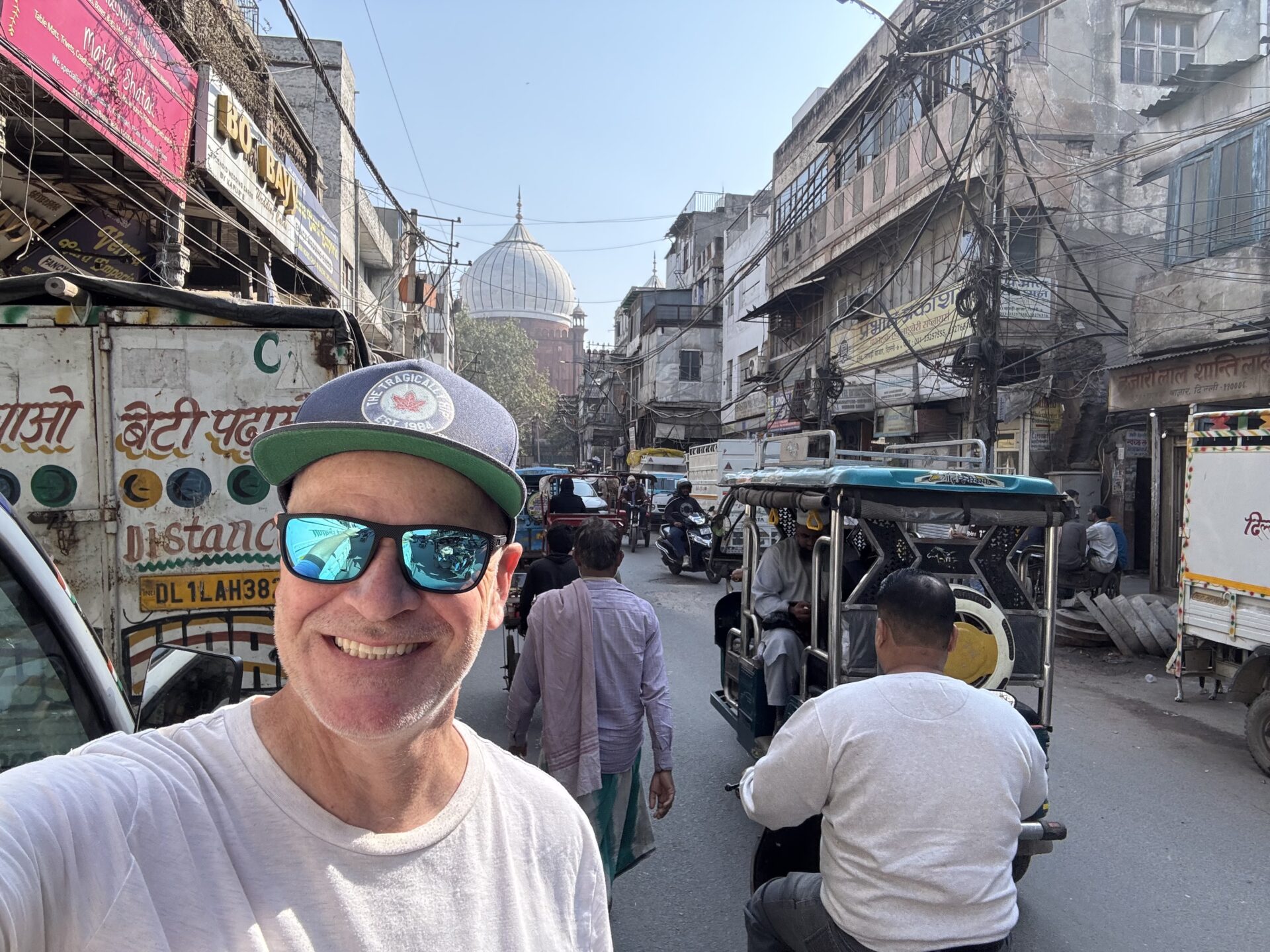
India is an incredible country and a bucket-list destination for many, including me. It is one of the most rewarding countries to travel to, but you do need to be aware of tourist scams to ensure an amazing experience. For the most part, tourist scams in India occur in the Golden Triangle (New Delhi, Agra, and Jaipur) and in Mumbai. I recently travelled across the country, visiting 12 cities, and it was only in this region that I had a problem.
Indian people are mostly honest, welcoming, and incredible hosts. I experienced so many acts of kindness in India that turned chaos into one of the best travel adventures of my life. My goal with this blog post is to raise awareness, not to create fear, so that these India tourist scams don’t ruin your trip, especially if you’re only visiting the Golden Triangle.

Common Tourist Scam Tactics
The most common tourist scams in India include fake tour guides, tuk-tuk scams, train station ticket scams, taxi overcharges, fake spiritual gurus, and tourist photo scams near major attractions. All the scams I encountered were non-violent and relied on confusion, pressure, or distraction. Understanding these scams will help you travel through India with confidence. This India scam guide for travelers is based on my real experiences and the common tactics travelers encounter.
👉 If you’re planning a trip to India and haven’t sorted out your visa yet, I’ve put together a comprehensive guide: Indian Tourist eVisa Guide: My Application Tips and Fixes. It walks you through the process step by step and helps you avoid common frustrations.
This post contains affiliate links, which means I may earn a small commission if you make a purchase through one of them at no extra cost to you. I only promote travel brands that I use myself.
Quick Warning Signs of India Tourist Scams
- Someone approaches you first in a tourist area
- They insist on helping without being asked
- You’re told an attraction is “closed today”
- Prices are unclear or constantly changing
- You’re pressured to decide immediately
- A tuk-tuk driver pushes tours or shopping stops
- Someone tries to move you away from crowded areas
- A “guru” or “psychic” quickly turns into a salesperso
Where Do Tourist Scams Happen Most Often in India?
Most scams occur in busy tourist zones where travelers are overwhelmed, distracted, or unfamiliar with local pricing. Be on high alert in New Delhi, Agra, Jaipur, and Mumbai. In Mumbai, the main concern is the Gateway of India area. Scams are most common at train stations, airports, famous landmarks (especially the Taj Mahal, Gateway of India, and India Gate), markets and bazaars, outside hotels and hostels, and tuk-tuk pick-up areas.

Most Common Tourist Scams in India
This is my list of travel scams I encountered in India. I am sure there are many variations, but this list should prepare you for the major tourist scams you may encounter in India.
Mumbai Tourist Scams
These are scams I encountered in Mumbai. Just because they are in my Mumbai section, that doesn’t mean you won’t encounter them in other parts of India, such as New Delhi or Agra.
1. The “Guru Blessing” Scam at the Gateway of India
How the Scam Works
A “guru” who looks legit approaches you for a free blessing. He asks about your family, gives you a flower for each member, hands you some mints, and puts a coloured mark called a tika on your forehead. He says the blessing will bring you good luck and good vibes, as long as you pay him, which in my case was 200 rupees.

What to Watch Out For
Legitimate Hindu gurus do not hang out at tourist attractions looking for people to bless. They definitely do not ask for money for a blessing to work. These people are not legitimate spiritual figures; they are scammers. Whenever you see this at places like the Gateway of India, it’s a scam.
What to do instead
If you would like to receive a blessing from a guru in India, ask your hotel or hostel for recommendations. They will know where to send you for a legitimate experience, likely nearby. You can also visit certain temples for this experience, such as the Golden Temple in Amritsar. However, be aware that some temples in tourist areas offer blessings, and the donation may go to the person giving the blessing.
2. The Gateway of India – Tour scam
How the scam works
The scammer meets you on the street on your way to the Gateway of India and starts with basic questions like, “Where are you from?” “Where are you staying?” “How long have you been in Mumbai?” He then tells you about his tour, which he says is completely different from anything else in Mumbai. After some persistence, you tell him you are good on your own, and you go your separate ways.

He reappears after you arrive at the Gateway of India and won’t leave until you agree to look at his tour itinerary. It’s high-pressure, and he is doing everything he can to get you away from the Gateway of India, the crowds, and anyone who might tip you off that this is a scam. Just say no, as that is when the extreme pressure will kick in.
The tour is very overpriced at 6000 rupees, about $65 USD. On top of this, they earn commissions at every stop, and the experience isn’t great, well below what was promised, and definitely a rip-off.
What to Watch Out For
If someone approaches you on the street, becomes your best friend, and then starts selling a tour, get out of that situation as fast as possible. If you see him again when you arrive at your destination, that’s a double red flag. Anyone who tries to get you away from populated tourist areas to take you to an office to discuss a tour is a red flag.
What to do instead
If you want to book a unique tour in Mumbai, I recommend Guru Walk’s free walking tours. I did 3 Guru Walk tours in Mumbai, and they were all amazing. Get Your Guide is another great tour company that ensures a great experience. You can also check with your hotel or hostel, as they often have tour desks with awesome tours.
👉This is my affiliate link for GetYourGuide Tours in Mumbai
Free Walking Tours in Mumbai
3. The Tourist Photo Scam at India Gate & Gateway of India
How the Scam Works
This is one of the most common tourist scams in India, especially at popular tourist attractions like the Gateway of India and India Gate in New Delhi. I even fell for it at India Gate, and here’s how it went down.
Just past the entrance, many professional photographers are waiting for tourists to walk in. One person approaches you to sell the experience and high-quality professional photos. He then brings you to his friend, who has the camera. They show you professional-quality, model-like photos they took of tourists with their expensive camera. You receive an offer of 100 rupees for a photo session, and they then bring it down to 50 rupees to close the deal. You are told they will take as many pictures as you like, and you just pick your favourites. I was like, why not? Let’s do this.
Next, they pulled me far away from the India Gate, and it was a long walk. We did our photo shoot, and I picked a few I liked. He said that’s 550 rupees. What? We said 50 rupees? He said no, 50 rupees per picture. Then they used pressure tactics, as if I were reneging on a deal. In the end, I agreed to buy 4 for 200 rupees. The pictures were okay, but I was misled about the price.

What to Watch Out For
When you walk into popular tourist attractions, especially in New Delhi, Agra, Jaipur and Mumbai, you will see many people walking around with cameras. They are easy to spot. If you’re approached, the price is ridiculously low, and the person tries to take you far away, it’s likely a scam.
What to do instead
If you have a friend with you, ask them to take your pictures with your iPhone. I didn’t see any pics that wouldn’t have been just as good with my iPhone in portrait mode. I know this might not be possible if you’re a solo traveler, but there are always locals who are more than happy to take your picture. If you don’t mind paying 50-100 rupees for an iPhone-quality picture, hire one of the photographers.
Quick Tip: Never let photographers take you away from crowded tourist areas
subscribe to my newsletter for Hidden Gems, Smart Tips, travel guides and Honest Reviews
New Delhi Tourist Scams
New Delhi is the mecca for tourist scams in India. You need to be on high alert at all times in Delhi, as scams are constant. The minute you let your guard down, they will get you. Trust me on this. Six of the 10 tourist scams on this list happened to me in New Delhi.
Tourist scams start the minute you land at the airport and continue as you take a taxi to your hotel, ride tuk-tuks around the city, meet people on the street, and arrive at the train station to travel to Agra. I’m not trying to hate on Delhi, but it’s scam central.
4. The Delhi Airport Taxi Surcharge Scam
How the Scam Works
After arriving at the airport in New Delhi, someone approaches you and asks where you are going. Once you share your destination, they claim that a festival, parade, protest, or religious event is affecting your route. They then say you need a special taxi ticket or permit, usually with an extra 500–1000 rupee surcharge.
The scammer may take you to a small office or counter where they issue a fake ticket or voucher for your taxi driver. In some cases, they may also try to redirect you to another hotel or travel agency that pays them additional commissions.
This is a scam. There are no special festival surcharges for regular airport taxis in Delhi, and legitimate taxi services do not require additional permits for local events or road closures.

What to Watch Out For
If you are approached at the airport or outside near the taxi stands by anyone trying to sell you a taxi service, just say no. Official taxi operators do not operate this way, and there are no taxi surcharges in New Delhi. This is a huge red flag.
What to do instead

Before arriving in New Delhi, check with your hotel or hostel to see if they offer an airport pick-up service. I arranged an airport pick-up with my hostel, which was hassle-free and only marginally more expensive than a regular taxi. If you choose to take a taxi from the airport, there are official stands where you can safely prepay. Uber is also available and is another safe option.
There is also a train to the city, which is the fastest way to get there. Remember, there are plenty of safe transportation options; just stay on high alert and don’t get scammed!
👉Hostels are a great way to safely arrange an airport pickup. Check out my blog on why I stay in Hostels while traveling.
5. The “Everything Is Closed” Tuk-Tuk Scam
This scam happened to me multiple times in New Delhi, Agra, and Jaipur. If you’re travelling through India’s Golden Triangle, stay alert when using tuk-tuks.
How the Scam Works
The scam usually starts with an unusually low fare. In my case, I agreed to pay 200 rupees for a ride to the Gandhi Museum in New Delhi.
Once we were on the road, the driver began asking questions about how long I’d been in Delhi and when I was leaving, trying to gauge my experience. He then started pushing an expensive sightseeing tour for 4000 rupees.
When I repeatedly declined, he switched tactics and claimed the Gandhi Museum might be closed.

“The Museum Is Closed”
As we arrived, the driver intentionally pulled up near the back entrance and pointed to staff in the distance, saying: “It looks closed, but I’ll go check.” I refused and walked to the front entrance myself. Sure enough, the museum was fully open.
Once he realized I wasn’t falling for the scam or agreeing to extra stops, the original 200-rupee fare suddenly jumped to 500 rupees. After arguing for a few minutes, I paid 400 rupees and left.
What to Watch Out For

When a tuk-tuk driver offers an unusually low fare, they are often planning to make money through shopping stops, commissions, or unwanted tours. If you refuse the extra stops, expect pressure or attempts to raise the original fare.
Also, avoid tuk-tuks with a second passenger already inside. The driver may claim the passenger is a friend or family member, but they are often there to pressure tourists into changing their plans or making additional stops.
What to do instead
The best way to avoid hassles is to take an Uber. Buses, trains, and, of course, my favourite, walking, are safe and reliable options in India as well.
If you are considering organized tours in India, book through your hotel or hostel, GetYourGuide, or Guru Walk for free walking tours. These options are safe, reliable, and hassle-free, offering a much better experience than a tuk-tuk scam tour.
Red Flag: If someone says an attraction is closed today, verify it yourself before agreeing to a tour.
👉Thailand is also well known for this tuk-tuk scam. If you are planning a trip to Thailand, check out my blog, How to Avoid These 3 Common Scams in Bangkok
Free Walking Tours in New Delhi
6. The Train Station Ticket Check Scam
How the Scam Works
As I was walking through security at the New Delhi train station, someone stopped me to check my ticket. Assuming he was an employee, I showed him my ticket, and he first told me it was incorrect. I double-checked the dates and times and knew it was correct, especially since I booked through one of my affiliate partners, 12Go.

He then tells me that my ticket was back in general admission with no assigned seating and that it would be very uncomfortable. He offers me an upgrade and invites me to come with him to a booking office so I could upgrade to assigned seating, even though my ticket clearly states that it is a 2nd class ticket with assigned seating.
There is so much chaos at the New Delhi train station that I was so overwhelmed and almost fell for this before realizing it was a scam.
What to Watch Out For
There are no ticket checkers outside train stations in India. I also had random people ask to see my ticket inside train stations in Jaipur, Agra and Mumbai. If this happens with someone posing as an employee, consider it a scam and assume they are taking you down the garden path.
What to do instead
Purchase a train ticket through an app like 12Go, and ignore anyone who asks you to confirm your ticket at the train station. That will not happen until you board the train.
Booking trains before arriving in India can be challenging for Western tourists. I use 12Go to book my train journeys while traveling through India. It’s easy, and once you book with them, they handle all the logistics.
👉 This is my 12Go affiliate link for booking trains in India.
7. The “Friendly Stranger” Detour Scam
How the Scam Works
You meet an overly friendly stranger while walking the streets, having a chai, or going about your day. They quickly act like your new best friend and insist they just want to help.

I experienced this in Delhi while trying to find my hostel after getting disoriented. A man approached me, asked where I was going, and said the street my hostel was on was closed. He offered to take me there via a different route.
The “different route” turned into a long detour with multiple stops at shops and restaurants, where he likely earned commissions by bringing in tourists. During the encounter, he also tried to offer me drugs, which immediately raised red flags.
This happened to me again in Jaipur, though the situation felt much less intimidating than in New Delhi.
What to Watch Out For
If someone randomly approaches you on the street and befriends you very quickly, put your guard up. Questions like where you are staying or how long you have been in New Delhi are usually red flags. If they insist on walking you through a detour, this is almost always the start of a scam.
What to do instead
Politely decline and act as if you know where you’re going, even if you don’t. Make Google Maps your friend, and if you’re still unsure, ask a local shop or restaurant owner. This is safer than a random stranger approaching you on the street.
8. The Hotel-to-Airport Taxi Scam
I mentioned earlier in this guide that I was targeted by airport taxi scams in New Delhi. Unfortunately, I was also scammed on the way back to the airport.
After several Uber cancellations, I asked my hotel to call a taxi because I was worried I would miss my flight.
How the Scam Works
The hotel told me the ride to the airport would cost 400 rupees, but when the taxi arrived, the fare immediately increased to 500 rupees.

Then, just before reaching the airport, the driver asked whether I needed departures or arrivals. When I said departures, he said it would cost an additional 250 rupees. At that point, I was stuck. He slowed down and looked back at me as if he was going to let me out right there. I couldn’t exactly get out and walk to the terminal with luggage while rushing for a flight, and the driver knew it.
To top it off, he conveniently didn’t have any change at the end of the ride. What started as a 400-rupee airport transfer ended up costing me 800 rupees.
What to Watch Out For
This is an India tourist scam that’s hard to escape. Once you are in the cab, you are at their mercy, and I can’t think of any signals that could have saved me from this scam.
What to do instead
First off, always try to order an Uber. If that fails, as it did in my case, negotiate up front. What I should have done was confirm that 500 rupees was the final price, then pay him. Next time, I would add, “That’s all the money I have.” I think I let my guard down because I was in such a panic to get to the airport. There were no train or bus options from where I was.
Jaipur Scam
9. The Gemstone Guru Scam
Jaipur is famous for tuk-tuk scams, and this was one I personally experienced. I met two tuk-tuk drivers on the train from Mount Abu to Jaipur. They seemed friendly, so we agreed on a city tour once I settled in.
How the Scam Works
The day started well. We toured all the hot spots, including Amber Fort, Hawa Mahal, the Pink City, and the Royal Gaitor. One of the drivers sat beside me throughout the tour, asking many personal questions about my life, family, travel blog, and travels. At the time, it felt like a harmless conversation.


Left: The Amber Fort and Right: The Royal Gaitor. All part of a perfect day in Jaipur before my “guru” reading, leading to the high-pressure gemstone scam. This is an India tourist scam to watch out for in Jaipur.
The “Guru” Reading
During the tour, the driver told me about a spiritual guru who had supposedly changed his life. He offered to bring me for a free reading at a jewellery store. Curious, I agreed.
The guru immediately began citing surprisingly personal details about my life, including my time in Peru, my family, and my career. I later realized most of this information had likely come from my conversations with the drivers earlier in the day — and possibly from my travel blog.
The Real Goal: Selling a Gemstone Ring
The reading quickly turned into a sales pitch. The guru claimed I needed an emerald gemstone ring to restore balance in my life and warned that things would keep going wrong if I didn’t buy one. The ring cost about $800 USD. I repeatedly declined as the drivers kept pressuring me before they eventually gave up. It was the only negative part of an otherwise incredible day in Jaipur.
What to Watch Out For
If your tuk-tuk driver suggests stopping at a jewellery store or another business during a tour, it is a major red flag. These stops are often commission-based. Claims that the owner is a guru, spiritual healer, or “special” person are usually part of the scam. Any hard-sell pressure is a serious warning sign.
What to do instead
The first thing to do—and what I should have done—is to refuse the stop as soon as the driver mentions a “guru” or claims that the owner of a jewellery store has special spiritual powers. These are common tactics used to encourage tourists to enter commission-based shops.
If you are looking to book a tuk-tuk tour in Jaipur, it is safer to arrange it through your hotel or hostel, as they typically use trusted local drivers. You can also book through platforms such as GetYourGuide, which offer a range of well-reviewed Jaipur tours and help reduce the risk of being taken to high-pressure sales stops.
I have also seen Jaipur tuk-tuk drivers with large Instagram followings and many positive reviews from Western travellers who report excellent experiences. However, as with any tour, it is still important to stay aware of potential commission-based shopping stops.
GetYourGuide Tours in Jaipur
Heading to Jaipur and interested in visiting the city’s iconic sites in one day on a tuk-tuk tour? Check out my blog,
10. The Milk Powder Scam
The milk powder scam is one of the most common tourist scams in India, and I’ve seen it throughout the country.
How the Scam Works
A woman—often presenting herself as a struggling mother with a baby—approaches tourists outside a shop and asks them to buy milk powder for the child. The tourist is directed to a nearby store to purchase it, usually at an inflated price.
In many cases, the shop is involved in the scam, either by reselling the products or by giving kickbacks to the scammer. The scam is framed as charity, pressuring tourists to buy quickly without questioning what’s really happening.
While it may seem like a simple act of kindness, this setup is often coordinated, and the money rarely goes where tourists think it does.
What to do instead
If someone asks you to buy something like milk powder or supplies, politely decline and keep moving. If you want to support people in need, give directly to reputable charities.

Other India Tourist Scams
Restaurant & Bar Menu Price Scam

In New Delhi and other parts of India, there are sit-down roadside restaurants. I got ripped off one night at one of them. I was walking back to my hostel from the Red Fort when I stopped at a roadside restaurant for a large King Fisher Strong and some snacks. It was a long walk, and I deserved a beer!
I ordered a beer, which wasn’t even a King Fisher; it was a fake, along with some spicy snacks. To add to this, I later learned it was non-alcoholic, so the joke was on me. There was no menu, and based on my time in Delhi, I expected the bill to be around 200 rupees at this type of establishment. When I asked for the bill, I noticed the staff were having a chuckle, which I knew wasn’t a good sign. When the bill came, it was 750 rupees. Yep, that’s a rip-off in India.
What to do Instead
If there is no menu, confirm the price before ordering. I should have done this, and I would have avoided this scam.
The “I Don’t Have Change” Tuk-Tuk Scam
When taking tuk-tuks or taxis in India, if you are paying in cash, don’t expect them to have change. Whenever I paid in cash, the driver never had change.
The easiest way to avoid this is to use Uber and ensure your credit or debit card is linked to your account. In India, you can book taxis, tuk-tuks, and motorbikes with Uber. If you are paying in cash, always have small bills on hand.
India Travel Safety and Avoid Scams Tips
Use ride apps when possible
- Uber and Ola reduce fare scams
- You avoid price negotiations
Never follow random strangers
- Especially near train stations and tourist attractions
Verify attraction closures yourself
- “Closed today” is one of the most common tourist scams in India
Agree on prices up front
- Tuk-tuks
- Photos
- Guides
- Taxi rides
Carry small bills
- Helps avoid “no change” scams
Be wary of high-pressure situations
- Scammers rely on rushed emotional decisions
Trust your gut
- If something feels off, walk away
Use Reputable Tour Companies
- Book tours through your hotel or hostel
- Use reputable online tour companies like GetYourGuide and GuruWalk
Travel Smart and Enjoy India With Confidence
India can feel overwhelming at first, especially in busy tourist hubs like New Delhi, Agra, Jaipur, and Mumbai, where tourist scams are common. But once you understand the most common tactics, most scams are easy to spot and avoid. In nearly every situation I encountered, the scams relied on confusion, pressure, distraction, or tourists simply not knowing what was normal.
Despite the scams I encountered, India remains one of the most rewarding, fascinating, chaotic, and unforgettable countries I’ve visited. The kindness, hospitality, food, culture, history, and energy of India far outweighed the negative experiences. Most Indian people are honest, welcoming, and genuinely curious to help travelers have a great experience.

The key is to stay alert without becoming paranoid. Trust your instincts, verify information for yourself, avoid high-pressure situations, and don’t let a few scammers ruin what could be one of the greatest trips of your life. With the right awareness and preparation, travelling in India can be an incredible adventure you’ll never forget.
👉If you are looking for some travel planning tips and best practices to help ensure a positive travel experience, check out my blog, My Long-Term Solo Travel Planning Methodology.
👉To find out what goes in my backpack, check out my blog, My Carry-On Packing List for Solo Travel: How to Pack Light
Follow my travel blog
Follow me on Social Media
TikTok – for quick travel tips and shorts
Instagram – for daily updates and photos
Spotify – listen to my solo travel podcast
YouTube – subscribe for full travel videos
Globe Digger AKA Geoff Josey is a travel blogger and solo traveler from Canada. I am a former corporate executive who realized there had to be more to life than just work, running the hamster wheel, and sleep. After exploring the world for 12 months, I never returned to my old life, now with a new outlook, and I share my journey through my blog, socials, and my podcast.

Leave a Reply